Abstract: Strong bank capitalisation provides long‑run financial‑stability benefits. However, transitioning to higher capital levels may involve short‑run costs. We analyse the effects of prudential capital changes on lending behaviour, macroeconomic outcomes, and banking competition using UK data within a structural VAR framework with sign and narrative restrictions. Narrative constraints draw on the UK regulator’s 2014–15 stress tests and the 2016 annual cyclical scenario. Impulse responses indicate that banks primarily adjust by reducing risk‑weighted assets rather than raising new equity. Higher capital requirements entail negligible long-run costs, with modest short-run macroeconomic effects consistent with other VAR studies on bank capital. These impacts are driven by a contraction in lending and increase in spreads across sectors. We find that effects of altering prudential capital requirements are state dependent. Altering during recessions, as compared with expansions, amplifies short-run contractions, but these are more short-lived, with output recovering more quickly. Indicators of market power (Boone, HHI, Lerner) suggest that tighter capital requirements temporarily reduce banking competition.
Abstract: In a monetary system in which risk-free and risky money coexist, Gresham’s law predicts that people will hoard risk-free money as a store of value and spend risky money as a medium of exchange. Establishing a payment system on the basis of risk-free money, such as a retail CBDC, while maintaining the fractional reserve banking system in place poses numerous challenges. In a laboratory experiment, we demonstrate that when the holding of risk-free money is unrestricted, people hold and pay with it extensively. However, when the ability to hold risk-free money is limited by a ceiling or an unattractive interest rate, people tend to hoard risk-free money and use risky money for payments.
Abstract: How do banks respond to transition risk and which mechanisms drive this response? We shed new light on this question using data on granular international large exposures of UK banks. Climate policy is the main source of transition risk we use. We find that an increase in climate policy stringency on average leads to a decline in the share of lending that is exposed to transition risk. However, this finding is not uniform across banks: banks with a lower initial exposure to transition risk decrease their transition-risk exposure by more and increase their transition-aligned exposure, while banks with a high initial exposure to transition risk further increase their exposure to those sectors. We also find evidence supportive of outward international spillovers through banks’ cross-border lending portfolios: banks increase transition risk-exposed lending to a given country if climate regulation gets tighter in other countries banks have such exposures to.
Abstract: Using data on four USD-pegged stablecoins and 27 fiat currencies, this paper documents spillovers from stablecoin-based foreign exchange (FX) to traditional FX markets. We document a gap between the cost of acquiring dollars via stablecoins and via the spot FX market (parity deviations). To establish a causal link between stablecoin flows and FX markets, we use a granular instrumental variable that exploits idiosyncratic shocks to stablecoin net inflows in other currencies. Our estimates indicate that a 1% exogenous increase in net stablecoin inflows raises parity deviations by 40 basis points, depreciates the local currency, and widens the dollar premium in synthetic funding markets (covered interest parity (CIP) deviations). A model of constrained arbitrage rationalizes these findings and provides structural foundations for the identification strategy. Counterfactual simulations show that halving cross-market frictions would attenuate CIP spillovers by roughly one-half and cut exchange rate effects by nearly one-third. A dynamic extension that closely matches the empirical impulse responses shows that spillovers grow disproportionately when intermediaries suffer losses, as depleted capital reduces their capacity to absorb further shocks. Our results establish stablecoins as an emerging segment of global currency markets with direct implications for financial stability.
Abstract: Payment stablecoins are privately issued digital money with the potential to enhance payment efficiency, foster innovation, and improve financial inclusion. At the same time, they are vulnerable to runs and associated welfare losses. One way to lower run risk is to require stablecoin issuers to hold safe assets. But doing so may lower issuers’ profitability and thus their incentive to provide stablecoins, hampering payment innovation and product variety. This paper offers a theoretical framework to navigate the tradeoff between maintaining stability and incentivizing issuance. Based on the Diamond and Dybvig (1983) model of bank runs, the paper shows that an unregulated private equilibrium is suboptimal. Stablecoin issuers hold risky assets to maximize profits, increasing run risk. A social planner can improve the equilibrium by requiring the backing of stablecoins with a safe asset (such as central bank reserves in a narrow bank setting), and creating conditions for other sources of revenue for issuers (such as central bank reserves remuneration or policies for payment data utilization). The model offers a baseline for the ongoing policy discussion while identifying considerations for further study.
Abstract: Conventional credit risk models understate tail risk by centering on mean default probabilities and neglecting distributional and sectoral heterogeneity. We propose a Quantile Probability of Default (QPD) framework based on unconditional quantile regressions estimated on flow default rates from five million non-financial firms across nine countries, conditioned on macro- and sectoral scenario covariates standard in stress testing. The tail exhibits three- to five-fold stronger sensitivity than at the median, revealing non-linearities and asymmetric sectoral propagation of credit risk. We validate the performance of our model across crisis periods and benchmark models to confirm the framework’s robustness and prudential efficiency. Under the European Central Banks’s 2025 increasing geopolitical and trade tensions scenario, the QPD identifies higher tail vulnerabilities in construction, trade, hospitality, and real estate. The framework embeds distributional estimation into stress testing, advancing scenario-based assessment of sectoral credit risk for policy and prudential applications.
Abstract: The proliferation of economic uncertainty indicators —ranging from text-based indices like the Economic Policy Uncertainty (EPU) index to market-based measures such as the VIX and the ECB’s Country-Level Index of Financial Stress (CLIFS)— has enriched the analytical toolkit of economists and policymakers. Yet these indicators often diverge, sending conflicting signals about the state of uncertainty in the economy. This paper argues that such divergence is not a flaw but a feature: each indicator captures a distinct dimension of uncertainty. Using topic modeling techniques applied to national news corpora, we construct a taxonomy of uncertainty narratives across five European countries and classify episodes of divergence between the EPU and CLIFS indicators. Our findings reveal systematic patterns: EPU peaks are predominantly driven by political and institutional developments, CLIFS peaks by financial market stress and joint peaks by systemic crises. These results underscore the multidimensional nature of uncertainty and highlight the need for structured interpretative frameworks. By linking narrative content to indicator behavior, our approach offers a novel lens for understanding uncertainty dynamics and provides practical tools for researchers and policymakers navigating an increasingly complex informational environment.
Abstract: Pacific Island Countries (PICs) face acute and rising climate adaptation needs due to high exposure to sea‑level rise, natural disasters, and structural vulnerabilities associated with small size and geographic remoteness. This paper develops a unified framework to produce the first region‑wide, internally consistent estimates of climate adaptation financing needs for PICs. A metadata analysis harmonizes country‑level assessments into comparable annual measures, while a complementary machine‑learning approach generates synthetic estimates for data‑deficient countries using economic, geographic, and climate‑vulnerability indicators, subject to differences in sectoral definitions and coverage embedded in the underlying source studies. The results show that adaptation needs are large, highly uneven across countries, and exceptionally high relative to GDP, particularly for atoll nations where physical risks dominate. The paper also examines climate adaptation finance flows to PICs over the past decade, distinguishing between commitments and estimated disbursements, and finds that current financing levels fall well short of projected needs. Disbursement ratios vary substantially across financing channels, reflecting differences in institutional capacity and project implementation. Taken together, the findings highlight substantial adaptation financing gaps in PICs and underscore the importance of strengthening institutional capacity and improving the effectiveness and accessibility of climate finance mechanisms.
The increasing frequency, severity, and unpredictability of natural disasters and chronic climate threats pose unprecedented challenges to global financial markets. Traditional asset pricing models and portfolio management frameworks often struggle to incorporate the stochastic nature of physical climate risks.
Currently, investors attempting to hedge against physical climate risk often rely on static, country-level vulnerability indices or long-term macroeconomic projections. These approaches fail to capture the high-frequency, dynamic nature of extreme weather events and their heterogeneous impacts across different industries and individual firms. The motivation of this research is to bridge this gap by connecting firm-specific asset intensity with the time-varying probability of extreme temperature anomalies, ultimately allowing for dynamic risk mitigation within a quantitative portfolio construction paradigm.
The core hypothesis is that while market participants are increasingly aware of transition risks (e.g., regulatory changes, carbon taxes), the immediate and localized impacts of physical climate shocks—such as floods, extreme heatwaves, and storms—are not yet fully priced into global equity variations. Addressing this requires granular data and a departure from standard variance models.
3. Methodology
3.1. Panel Regression Analysis and Sectoral Impact
The foundation of the study is a robust panel regression analysis conducted on historical sectoral returns. We focus on extreme temperature events, formalizing them as localized temperature anomalies. By regressing sectoral equity returns against these anomalies, we provide strong statistical evidence that extreme temperature shocks exert a quantifiable negative effect on the majority of economic sectors. Notably, the empirical findings show statistically significant adverse impacts not only in traditionally exposed sectors like agriculture or industrials, but also in sectors such as Retailers and Software & IT Services, highlighting the widespread vulnerability of supply chains and technological infrastructure.
3.2. Novel Climate Risk Metrics: CRE and CEV
To operationalize these findings for portfolio optimization, we introduce two novel, dynamic metrics designed to measure the environmental vulnerability of an investment portfolio:
Climate Risk Exposure (CRE): A measure of the expected impact of temperature anomalies on a portfolio, taking into account the firm-specific asset intensity and geographic distribution of operations. It represents the aggregate vulnerability of the portfolio to realized and expected physical climate shocks.
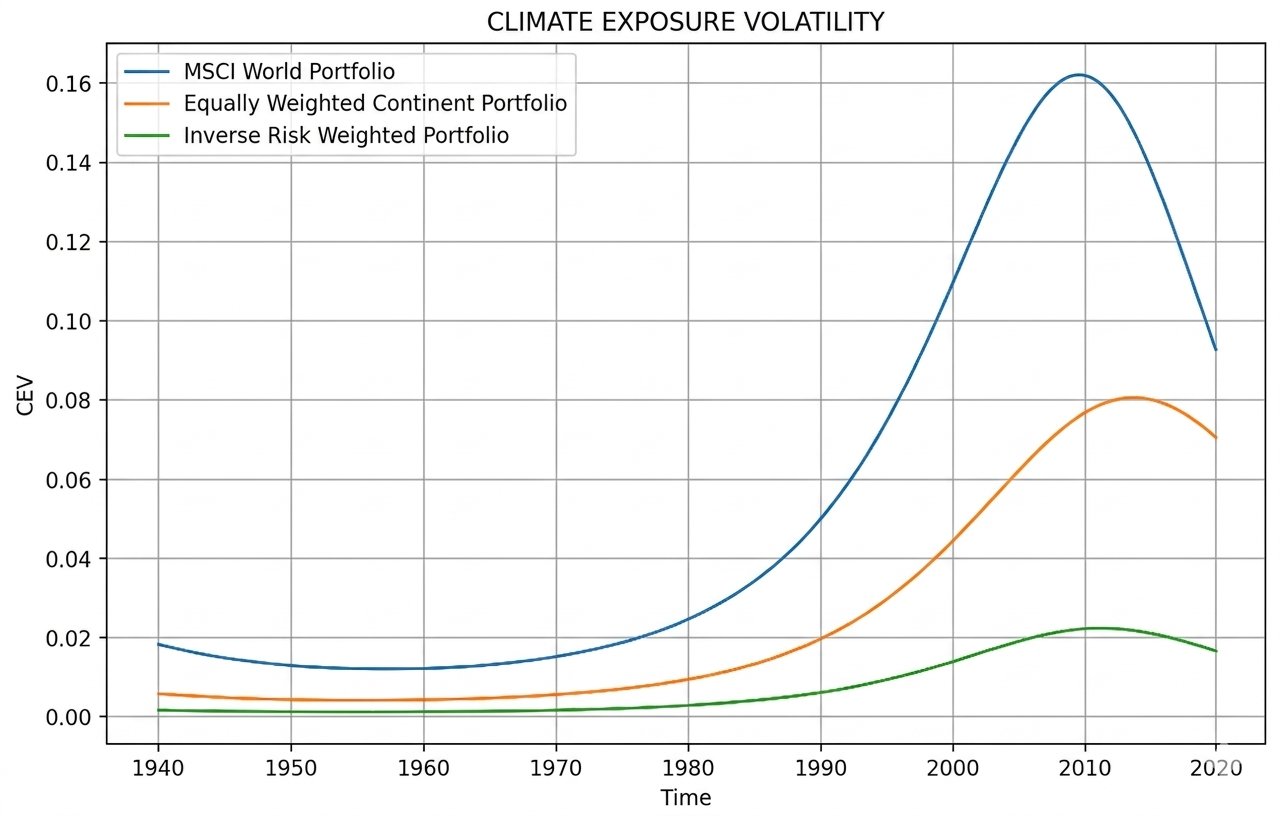
Climate Exposure Volatility (CEV): A metric capturing the variance or uncertainty associated with the portfolio’s climate risk exposure. This highlights that climate risk is not static; the probability of extreme events varies over time, and CEV measures the stability of the portfolio’s climate resilience.
By utilizing realized temperature anomalies and multiplying them by climate-normalized asset weights, the metrics are aggregated geographically to produce a robust monthly indicator of risk. These indices provide a much more responsive tool compared to static ESG scores.
3.3. Multi-Objective Portfolio Optimization
The core contribution of the paper is the integration of CRE and CEV into a multi-objective portfolio optimization framework. This novel approach extends the classical Markowitz Mean-Variance paradigm by adding climate risk dimensions. Investors are no longer restricted to optimizing the trade-off between expected financial return and financial variance; they can now actively minimize Climate Exposure Volatility (CEV) or constrain Climate Risk Exposure (CRE). This allows for the construction of portfolios that are explicitly resilient to physical climate shocks while maintaining desired levels of financial diversification.
4. Backtesting
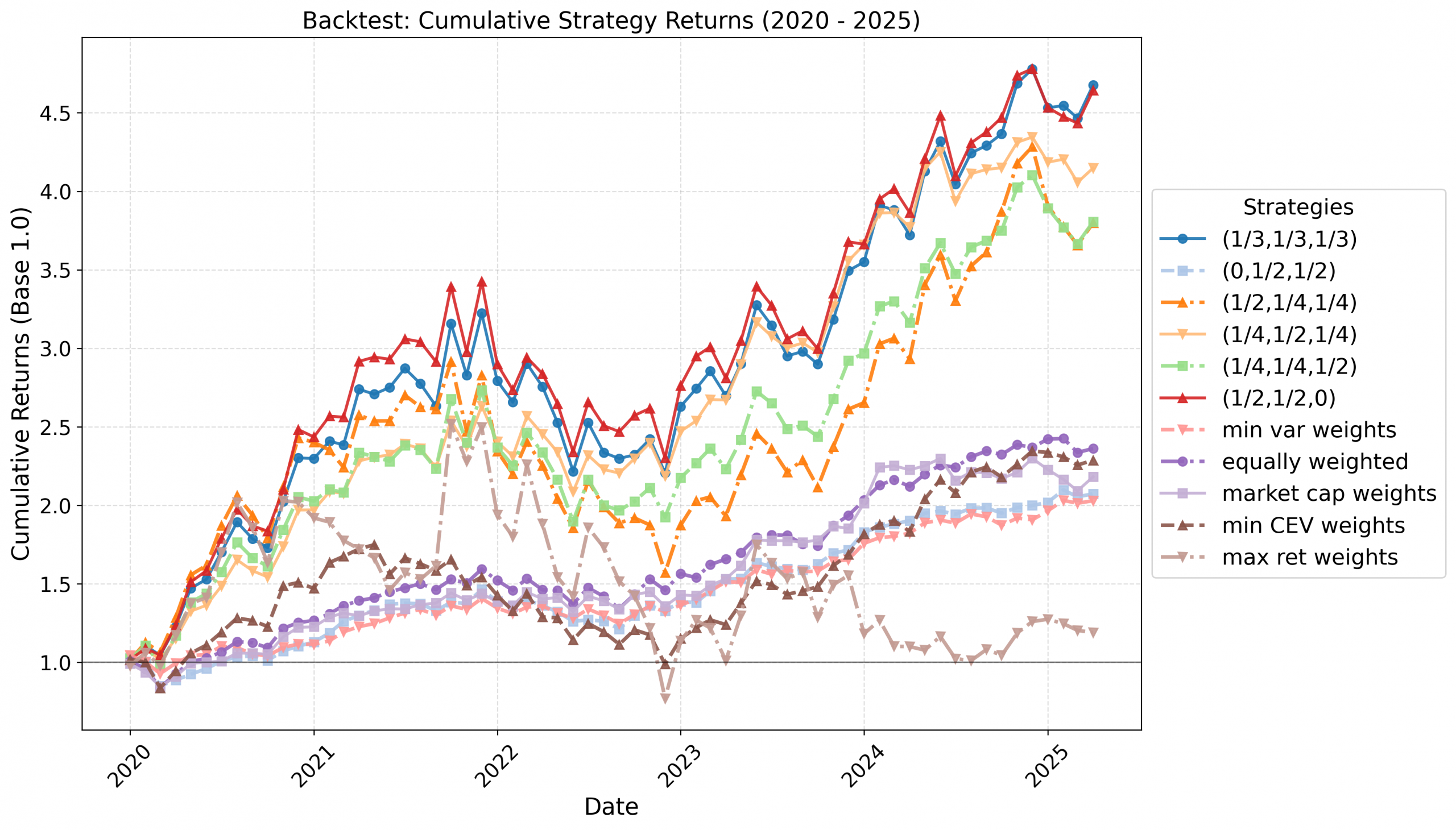
To show the practical benefits of the proposed methodology, we conduct an extensive backtesting analysis over the period from January 2020 to April 2025.
The study compares three distinct portfolio strategies to evaluate the trade-offs between traditional optimization and climate-aware frameworks. By plotting the evolution of CEV across these three strategies, we discuss how active management of climate risk exposure leads to superior resilience during periods of heightened climatic stress.
The out-of-sample performance metrics reveal that incorporating CRE and CEV into the investment process does not come at an unacceptable cost to financial returns. Instead, the climate-aware strategies perform competitively relative to traditional benchmarks, while offering significantly lower drawdown profiles during periods characterized by high global temperature anomalies and associated natural disasters. The inclusion of firm-specific physical footprints allows for highly targeted reallocations that preserve the core equity premium.
5. Conclusion
We provide a highly practical, statistically grounded methodology for addressing one of the most pressing risks in modern quantitative finance. By introducing dynamic, firm-level and temperature-driven metrics (CRE and CEV) and embedding them into a multi-objective optimization framework, we offer a blueprint for constructing resilient global equity portfolios. This approach empowers asset managers to systematically mitigate the adverse effects of physical climate risk, ensuring long-term portfolio stability without sacrificing the benefits of broad market diversification.
This paper investigates the optimal execution and pricing of financial contracts commonly used in merger and acquisition (M&A) transactions, focusing on agreements between a broker and a counterparty. In particular, we analyze three classes of contracts: linear instruments such as Total Return Swaps (TRS), nonlinear structures such as collar contracts, and path-dependent contracts based on Time-Weighted Average Price (TWAP).
In M&A operations, acquiring firms often rely on derivatives rather than direct stock purchases to build positions in a target company while mitigating market impact and complying with regulatory constraints. Through such contracts, the broker intermediates the acquisition process by gradually executing trades in the underlying asset and managing inventory. These arrangements provide flexibility but also introduce significant challenges in pricing, hedging, and execution due to market illiquidity and price impact.
We develop a framework in which the broker determines both the optimal trading strategy and the contract fee using an indifference utility approach. The model incorporates both temporary and permanent linear market impact, capturing the feedback effect of trading activity on asset prices. Within this setting, the broker simultaneously hedges the derivative exposure and manages inventory over the contract’s lifetime, under either cash settlement or physical delivery.
Our analysis extends existing literature on illiquid derivative pricing by considering a broader class of payoff structures, including linear, nonlinear, and path-dependent contracts. We show that the nature of settlement plays a crucial role. Cash-settled contracts are systematically more expensive than physically delivered ones. The intuition is that, under cash settlement, the broker must unwind the hedging position at maturity, incurring additional market impact costs, whereas physical delivery aligns the hedging activity with the final obligation.
A central contribution of the paper is the analysis of market manipulation and statistical arbitrage opportunities arising from these contracts. We demonstrate that linear cash-settled contracts are particularly vulnerable to manipulation. The broker’s trading incentives are time-inconsistent: early in the contract, trading is driven by hedging needs, while near maturity, inventory liquidation dominates. This shift can induce trading patterns that exploit price impact, leading to profitable round-trip strategies (statistical arbitrage). In contrast, physically delivered contracts significantly reduce these opportunities, as the broker’s trading remains aligned with the need to accumulate shares for delivery.
We further show that nonlinear contracts, such as collars, introduce additional complexity, as optimal trading strategies become state-dependent and react dynamically to price movements. Similarly, TWAP-based contracts, due to their path dependence, can also generate manipulation incentives and statistical arbitrage opportunities, as the broker may influence the average price through strategic execution.
Overall, the paper delivers two key findings. First, cash settlement increases the cost of contracts relative to physical delivery due to the necessity of position unwinding under market impact. Second, cash-settled and path-dependent contracts are more prone to manipulation and statistical arbitrage, while physical delivery provides a more robust structure by aligning incentives between hedging and execution.
These results contribute to the literature on derivative pricing under illiquidity and to the growing body of work on market manipulation in price impact models, offering practical insights for the design and regulation of M&A-related financial contracts
Questo sito utilizza cookie tecnici e di profilazione, propri e di terze parti, per garantire la corretta navigazione, analizzare il traffico e misurare l'efficacia delle attività di comunicazione.
Questo sito Web utilizza i cookie per migliorarne l'esperienza di navigazione. I cookie classificati come necessari, sono essenziali alle funzioni di base sito e vengono sempre memorizzati nel tuo browser. I cookie di terze parti, che ci aiutano ad analizzare e capire come utilizzi questo sito, vengono memorizzati nel tuo browser solo con il tuo consenso. Di seguito hai la possibilità di disattivare questi cookie. Tieni in conto che la disattivazione di alcuni di questi cookie potrebbe influire sulla tua esperienza di navigazione.
Necessary cookies are absolutely essential for the website to function properly. These cookies ensure basic functionalities and security features of the website, anonymously.
Cookie
Durata
Descrizione
cookielawinfo-checkbox-analytics
1 year
Cookie tecnico impostato dal plugin GDPR Cookie Consent che viene utilizzato per registrare il consenso dell'utente per i cookie nella categoria "Analitici".
cookielawinfo-checkbox-necessary
1 year
Cookie tecnico impostato dal plugin GDPR Cookie Consent che viene utilizzato per registrare il consenso dell'utente ai cookie.
CookieLawInfoConsent
1 year
Cookie tecnico impostato dal plugin GDPR Cookie Consent per salvare le scelte si/no dell'utente per ciascuna categoria.
viewed_cookie_policy
1 year
Cookie tecnico impostato dal plugin GDPR Cookie Consent che registra lo stato del pulsante predefinito della categoria corrispondente.
Analytical cookies are used to understand how visitors interact with the website. These cookies help provide information on metrics the number of visitors, bounce rate, traffic source, etc.
Cookie
Durata
Descrizione
_pk_id.gV3j99y0AE.0928
1 year 27 days
Cookie analitico impostato da Matomo e utilizzato per memorizzare alcuni dettagli sull'utente come l'ID univoco del visitatore
_pk_ses.gV3j99y0AE.0928
30 minutes
Cookie analitico impostato da Matomo di breve durata e utilizzato per memorizzare temporaneamente i dati della visita