POSTPONED TO JUNE 10-11, 2021 DUE TO THE COVID-19 EMERGENCY
www.mate.polimi.it/fintech
Big Data and Machine Learning are driving
a significant transformation in the financial industry. Amazing examples
include: robo-advisory; predicting frauds in payment systems; development of sophisticated
algorithmic trading strategies; systemic risk assessment; rating of
companies/financial products using a huge amount of information; development of
chatbots for customers; nowcasting of financial time series; digital marketing;
instant pricing of insurance products.
The transformation concerns the
academia and the financial industry. The goal of the conference is to bring
together academicians with different backgrounds (economists, finance experts,
data scientists, econometricians) and representatives of the financial industry
(banks, asset management, insurance companies) working in this field.
Papers on all areas dealing with Machine
Learning and Big Data in finance (including Natural Language Processing and
Artificial Intelligence techniques) are welcomed. The conference targets papers
with different angles (methodological and applications to finance).
Invited speakers:
Tomaso Aste (University College London)
Emanuele Borgonovo (Università Bocconi)
Orlando Machado (Aviva Quantum)
Juri
Marcucci (Bank of Italy)
Georgios
Sermpinis (Adam Smith Business School, University of Glasgow)
Submission of the papers deadline: March 30th, 2021
Notification deadline: April 20th, 2021
Scientific
Committee:
Emilio Barucci (Politecnico di Milano, chair), Filippo Della Casa (UNIPOL), Paolo
Giudici (Università di Pavia), Daniele Marazzina (Politecnico di Milano), Andrea
Prampolini (Banca IMI), Marcello Restelli (Politecnico di Milano).
I tassi IBOR svolgono un ruolo fondamentale nei mercati
finanziari: in particolare il LIBOR è il tasso di interesse predominante per i
contratti (ad esempio interest rate swap, mutui, obbligazioni a tasso
variabile) nelle valute USD, GBP, CHF e JPY, mentre l’EURIBOR è il tasso più
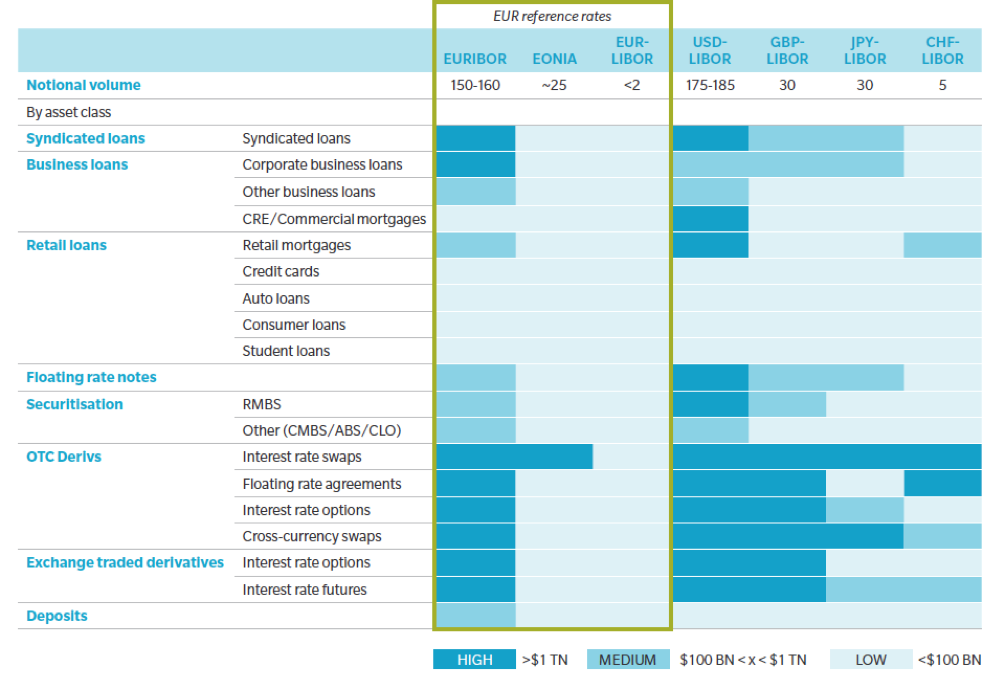
diffuso per i contratti dell’area Euro (cfr. Figure 1).
A seguito della crisi finanziaria, tuttavia, la loro affidabilità e coerenza sono state messe in discussione per le acclarate manipolazioni e per il calo della liquidità del mercato interbancario. La crisi ha inoltre determinato una esplosione delle basi quotate fra tassi che differiscono per divisa o tenor, con conseguente moltiplicazione delle curve di tasso necessarie per valutare a mercato gli strumenti finanziari, e la necessità di gestire il corrispondente basis risk [1]. Tali basi sono la conseguenza del meccanismo di fixing dei tassi, riferiti a depositi interbancari a termine unsecured, e riflettono essenzialmente il rischio di credito e liquidità delle banche partecipanti (IBOR panel banks).
A partire dal 2009, le autorità e gli operatori del mercato hanno
intrapreso una serie di iniziative per rinnovare la governance dei principali
tassi d’interesse di riferimento e per individuare nuovi tassi basati su
transazioni reali in mercati di riferimento stabili e liquidi. In particolare,
i “Principles for Financial Benchmarks” emanati da IOSCO nel 2013 stabiliscono
4 aspetti principali per la determinazione dei tassi benchmark: Governance,
Quality of Benchmark, Quality of Methodology ed Accountability. Tali principi
sono stati accolti nell’area Euro dalla Benchmark Regulation (BMR), che
dichiara i tassi EURIBOR ed EONIA come “critical benchmark” ed impone quindi,
entro due anni dall’entrata in vigore (ovvero entro il 1 gennaio 2020), una
loro revisione per renderli aderenti oppure una loro sostituzione.
Il Financial Stability Board (FSB) ha raccomandato di rafforzare
tali tassi di interesse, ancorandoli a transazioni osservabili, consigliando lo
sviluppo di nuovi tassi risk free (RFR). A questo fine sono stati predisposti
cinque Working Group per le principali valute, che hanno individuato i
rispettivi RFR alternativi: in tutti i casi si tratta di tassi overnight
(secured per alcune divise ovvero unsecured per altre). Per la divisa USD è
stato scelto il tasso SOFR (Secured Overnight Financing Rate), mentre per EUR è
praticamente definito il nuovo tasso ESTER (Euro Short Term Rate, unsecured). I
tassi overnight, specialmente secured, non sono strettamente tassi privi di
rischio, ma possono essere considerati come buone approssimazioni in tal senso.
Nel luglio 2018 AFME, ICMA, ISDA, SIFMA e SIFMA AMG hanno
pubblicato l’esito della consultazione rivolta agli operatori di mercato, nella
quale vengono identificati i punti di attenzione della riforma dell’IBOR e le
raccomandazioni sugli step da effettuare per prepararsi al passaggio ai nuovi
RFR e dalla quale è emerso che esistono carenze sostanziali circa la
consapevolezza della tematica e gli step finora intrapresi per gestire la
transizione.
Transizione
I nuovi contratti conclusi dopo la scadenza BMR (1° gennaio 2020)
dovranno essere riferiti ai nuovi RFR. I contratti pre-esistenti (legacy
contracts) potranno essere re-indicizzati ai nuovi RFR oppure, se continueranno
ad essere pubblicati, contare ancora sui vecchi tassi IBOR. In entrambi i casi
sarà necessaria una modalità di transizione (“fallback”) verso i nuovi RFR.
Un passaggio molto importante in tale transizione sarà la
costruzione di una struttura a termine per i tassi RFR, sostitutiva
dell’analoga struttura a termine oggi quotata per i tassi IBOR sotto forma di
tassi di deposito, Futures, FRA (Forward Rate Agreement), e Swap. I nuovi RFR,
non disponendo di una struttura a termine con diverse scadenze, richiedono la
definizione di una regola per costruire dei tassi a termine. Ad esempio il
tasso a 3 mesi può essere costruito come composizione semplice dei tassi overnight
sul periodo. Questo tipo di indicizzazione è già ad oggi utilizzata per gli
strumenti di tipo OIS (Overnight Indexed Swap) scambiati sul mercato OTC. Sarà
poi necessario lo sviluppo di un mercato OTC liquido per tali strumenti
finanziari.
L’ISDA ha avviato un’iniziativa a livello internazionale per
identificare regole di fallback condivise per gli strumenti derivati, le quali
entreranno in vigore nel momento dell’interruzione permanente nella
contribuzione degli attuali benchmark. La soluzione di fallback si basa
sull’individuazione di un term adjustment e di uno spread adjustment da
applicare al RFR individuato. A luglio 2018, l’ISDA ha lanciato una prima
consultazione con la proposta di 4 metodologie alternative per il calcolo del
term adjustment e 3 metodologie per il calcolo dello spread adjustment, per le
divise GBP, CHF, JPY, i cui risultati sono attesi entro dicembre 2018. Una
successiva consultazione verrà lanciata per USD ed EUR nel 2019.
Tale metodologia, una volta definita e condivisa, sarà tuttavia applicabile per i soli derivati stipulati sotto ISDA agreement, mentre per gli altri strumenti (e.g. derivati non-ISDA, mutui, titoli) la conversione dovrà essere stabilita e non necessariamente avrà luogo con metodi analoghi, con il rischio di far emergere possibili basis mismatch e conseguenti conflitti contrattuali.
Area Euro
La normativa BMR ha sancito la fine dei tassi EONIA ed EURIBOR
così come li conosciamo. L’European Money Markets Institute (EMMI),
amministratore di entrambi i tassi, sta effettuando una revisione delle
metodologie attuali.
Per quanto riguarda l’EONIA, dopo una fase di studio, l’EMMI ha
ritenuto che la liquidità di mercato alla base del meccanismo di formazione
dell’EONIA non sia sufficiente per renderlo conforme alla BMR, e si è resa
quindi necessaria l’identificazione di un nuovo RFR in sua sostituzione. A tal
proposito l’European Central Bank (ECB) ha instituito il Working Group
sull’Euro Risk Free Rate, che il 13 settembre 2018 ha suggerito l’ESTER
(European Short Term Rate) quale nuovo RFR per l’Euro. Mentre l’EONIA è un
tasso di lending basato su depositi interbancari overnight effettuati sulla
piattaforma Real Time Gross Settlement (RTGS) operata dall’ECB, ESTER è un
tasso borrowing basato delle transazioni riportate dalle banche tramite il
Money Market Statistical Reporting (MMSR), e viene calcolato come media
ponderata sui volumi superiori al milione di euro, escludendo il primo 25% e
l’ultimo 25% della distribuzione dei tassi. L’ESTER, sviluppato dall’ECB
stessa, sarà ufficialmente pubblicato a partire da ottobre 2019; nel frattempo,
viene pubblicato un tasso pre-ESTER (osservazioni giornaliere a partire dal
marzo 2017 con la medesima metodologia di calcolo utilizzata a tendere) allo
scopo di familiarizzare con il nuovo tasso. I dati finora pubblicati dimostrano
che pre-ESTER è inferiore all’EONIA di circa 8-9 bps e maggiormente stabile
(minore volatilità storica e minori spike).
Per quanto riguarda l’EURIBOR, EMMI ha definito una metodologia
ibrida, attualmente in consultazione, che mira a superare le problematiche
dell’attuale metodologia di calcolo con lo scopo di ottenere un tasso che
minimizzi le possibilità di manipolazione e risulti ancorato a transazioni
osservabili e resistente agli stress del mercato. Nel caso in cui tale
metodologia venisse accettata dai regolatori come aderente ai principi IOSCO e
la BMR (scadenza 1° gennaio 2020), il nuovo EURIBOR potrebbe presumibilmente
essere il naturale successore dell’EURIBOR attuale. Nel caso in cui, invece,
l’EURIBOR subisse la medesima sorte del LIBOR, anche l’area Euro si troverà ad
affrontare le medesime problematiche delle altre principali divise. Al
riguardo, nello stesso documento in cui veniva sancita la scelta dell’ESTER
come nuova tasso risk free, il Working Group sull’Euro RFR ha suggerito di
utilizzare l’ESTER come base di partenza per costruire un nuovo tasso benchmark
in sostituzione dell’EURIBOR.
Impatti
A seguito della riforma, che avrà un impatto trasversale a tutti i
mercati, le aree in cui si possono individuate gli effetti più importanti
riguardano la liquidità degli strumenti di mercato indicizzati ai nuovi tassi,
la costruzione di nuove curve di tasso e superfici di volatilità, la modifica
delle metodologie di pricing, delle coperture, e il calcolo dei rischi. Saranno
inoltre di primaria importanza gli aspetti legali, con una possibile revisione
di tutti i contratti indicizzati ai tassi oggetto di transizione, e la gestione
della clientela per gestire possibili effetti di mismatching e di litigation.
Inoltre, si porrà la necessità di effettuare modifiche ai processi aziendali ed
alle infrastrutture IT. Al riguardo, sarà necessario porre molta attenzione
sulla governance complessiva del processo di transizione, al fine di assicurare
la coerenza tra gli impatti dei cambiamenti imposti dalla riforma e di gestire
i relativi rischi.
In particolare, per quanto riguarda i rischi di mercato, si posso
identificare i seguenti temi più rilevanti.
Contribuzioni tassi benchmark: le banche coinvolte nella contribuzione dei tassi benchmark dovranno gestire la transizione verso la contribuzione dei nuovi tassi secondo le nuove regole stabilite dagli organismi di riferimento (ECB per ESTER e prevedibilmente EMMI per EURIBOR per l’area Euro).
Dati di mercato: andrà gestita la transizione verso i nuovi tassi benchmark utilizzati come fixing per la valutazione dei contratti ed i relativi strumenti di mercato indicizzati a tali tassi. Andranno inoltre gestite le corrispondenti serie storiche per finalità di risk management (cfr. oltre).
Curve e volatilità tasso: utilizzando i nuovi strumenti di mercato indicizzati ai nuovi tassi benchmark, andranno inoltre costruite le curve di tasso e superfici di volatilità, gestendo i probabili problemi di liquidità nel caso in cui il mercato dei nuovi derivati indicizzati a RFR non sia abbastanza liquido e/o i dati non presentino una appropriata granularità. Inoltre è prevedibile un periodo di transizione in cui sarà necessario mantenere sia le vecchie curve e volatilità IBOR-based che le nuove curve e volatilità basate sui nuovi RFR.
Collateral management: in caso di revisione dei tassi di interesse utilizzati per la remunerazione del collaterale, andrà gestita la transizione verso i nuovi tassi di marginazione con conseguente revisione di tutti gli accordi di collateralizzazione.
Metodologie di pricing: le revisioni di dati di mercato, curve e volatilità tasso ed accordi di collaterale porterà probabilmente ad una conseguente revisione delle metodologie di pricing degli strumenti finanziari, che si articolano sotto vari aspetti come segue.
La revisione dei tassi di remunerazione del collaterale implicherà un adeguamento delle curve di scontro utilizzate per l’attualizzazione dei flussi futuri, con conseguenti impatti di sensitivity e P&L.
Un ulteriore impatto può determinarsi negli aggiustamenti valutativi, in particolare nelle misure di credit/debt/funding value adjustment (CVA/DVA/FVA) relative alle operazioni non soggette a collateralizzazione, dovuto all’impatto sulle esposizioni future e allo spread di finanziamento.
Possibili fasi di illiquidità e di passaggio di curve e volatilità tasso potranno determinare problemi di calibrazione dei modelli di pricing e conseguenti instabilità di prezzi, sensitivity e P&L.
In caso di dismissione dei tassi IBOR in favore di tassi risk free si avrà una semplificazione nel numero delle curve e volatilità di tasso necessarie per valutare gli strumenti, ed una semplificazione delle corrispondenti sensitivity (delta e vega in particolare). Di conseguenza si potrà determinare anche una semplificazione dei modelli di pricing, con un ritorno di fatto al mondo mono-curva risalente al periodo pre-crisi 2007.
Scenari storici: le nuove curve e volatilità tasso potrebbero non avere, dapprincipio, sufficiente profondità storica per costruire degli scenari storici, con conseguente impatto sulle metriche di rischio che si basano sui dati di mercato storici (e.g. historical VaR).
Trading vs Banking Book: date le diverse composizioni e metriche di rischio, si avranno impatti diversi: in particolare, per il Trading Book si rileverà un impatto su VaR, sensitivity, CCR e CVA, mentre per il Banking Book la transizione avrà effetti sulle masse di Bond, Loan e altri strumenti di cartolarizzazione, sia in termini di liquidità che in termini di rischio di tasso di interesse.
Basis risk: nel caso in cui l’adozione dei nuovi RFR avvenga a velocità diverse, ad es. più velocemente per i derivati e più lentamente per gli strumenti cash, anche in funzione della divisa, sarà necessario gestire una situazione ibrida con diverse asset class esposte a diversi tassi ed il conseguente rischio base.
Impatti sul capitale: la transizione verso i nuovi tassi benchmark richiederà l’identificazione dei possibili impatti sulle metriche di assorbimento di capitale; ad esempio, la mancanza di dati storici sui nuovi RFR potrebbe avere degli impatti alla luce della nuova regolamentazione per il Trading Book (FRTB), dove un punto cruciale per il calcolo delle metriche è la distinzione fra “modellable” e “non-modellable risk factors”.
Modelli Interni di Rischio: le eventuali variazioni di modello andranno gestite nell’ambito delle regole vigenti per i modelli interni (cfr. EBA RTS 2016/07 e manuale TRIM).
Figure 1: Notional outstanding balances by reference rate, order of magnitude US$ Trillion as of Dec 2017. Source: Oliver Wyman, Jun.2018
Note
[1] Ad esempio, per gestire i derivati di tasso in divisa EUR il mercato utilizza 5 curve (OIS, EURIBOR 1M, 3M, 6M, 12M) e almeno 6 superfici di volatilità (Cap/Floor EURIBOR 1M, 3M, 6M, 12M, Swaption EURIBOR 3M, 6M). Molte altre curve sono necessarie per gestire derivati e/o collateral cross currency.
Abstract: In McMahon et al. (2024) the authors demonstrated the effectiveness of a hybrid quantum solver in improving the liquidity efficiency of Canada’s high-value payments system (HVPS), altering the payment queue in order to minimize liquidity requirements. In this work, we apply a similar technique to the Italian segment of TARGET2, the Eurosystem’s HVPS, using the Constrained Quadratic Model (CQM) solver provided by D-Wave. This application achieves improvements in optimizing payment batches of size 70 and 140, showing daily average liquidity savings of respectively EUR 23 million and EUR 38 million over a 35 days sample. In addition we clarify the causes and possible extent of the liquidity savings realized. Introducing a machine learning framework to identify batch features that enhance liquidity savings, we find that batch optimizability increases with the number of participants acting as both senders and receivers, as well as the number of unique receivers within the batch. Finally we benchmark the CQM solver results against those obtained using a simulated annealing algorithm (SAA) under the same time constraints, finding comparable liquidity savings for batch sizes of 70 and 140 payments. The SAA is extended to handle batch sizes of up to 700 payments, a scale that is challenging for current quantum hardware, demonstrating a more than tenfold increase in liquidity savings.
Abstract: We show that the parameters of a broad class of portfolio-balance models can be recovered from estimates of Gaussian dynamic term structure models (GDTSMs) using a two-step estimator that bypasses the fixed-point problem that characterizes portfolio balance models. Specifically, we develop a novel canonical representation of bond supply in terms of factor-mimicking portfolios, whose returns replicate the structural shocks to the pricing factors. We identify these structural shocks by assuming that each shock corresponds to a distinct, mutually exclusive dimension of bond-supply variation. Using U.S. Treasury yields and macroeconomic data, we show the recovered shocks admit interpretations as hedging-risk-premium, risk-bearing-capacity, and monetary policy shocks.
Abstract: Theory suggests inflation risk premia are positive when supply shocks are expected to dominate demand shocks and negative otherwise. We measure these beliefs using demand and supply narratives derived from inflation news via Causality Extraction, which identifies causal relations between inflation and its drivers. Using narrative extracted from inflation news from the Financial Times for the Euro Area and the Wall Street Journal for the US, our key variable, NetDemand, measures the difference in articles attributing inflation to demand versus supply factors. Consistent with asset pricing theory, inflation risk premia are inversely related to NetDemand across maturities in both regions. This relationship holds even after controlling for the composite PMI and VIX, strengthens with risk aversion in the US and inflation volatility in the Euro Area, and is not subsumed by other measures of demand and supply contributions to inflation, views of professional forecasters, or narratives obtained from LLMs.
Abstract: Firms’ hurdle rates exceed their financial cost of capital. This gap varies across firms and has widened in the aggregate. In our Schumpeterian model, two frictions drive this gap: firm decision-makers require an innovator’s risk premium for undiversifiable innovation risk, and innovation profits are imperfectly pledgeable. Higher undiversifiable risk lowers the financial cost of capital while hurdle rates remain sticky or even rise. Widening gaps weaken creative destruction; profits and superstar valuations rise despite firms forgoing positive-NPV projects. The calibrated model matches cross-sectional patterns in gaps, R&D, market power and firm dynamics, and explains weak productivity growth and declining dynamism.
Abstract: This paper studies the financial-market transmission of the April 2025 U.S. tariff announcements, with a particular focus on the unusual combination of dollar depreciation and rising long-term U.S. Treasury yields. We ask whether the market reaction can be understood as the propagation of a single tariff-announcement shock or whether it instead reflects the interaction of distinct macro-financial disturbances. To address this question, we exploit time variation in the volatility and excess kurtosis of structural shocks to recover macro-financial forces without imposing event-based restrictions or exclusion assumptions. Our results show that the initial market reaction is consistent with a conventional safe-haven shock, but this mechanism cannot account for the subsequent joint behaviour of exchange rates and long-term U.S. Treasury yields. Instead, different segments of financial markets are dominated by distinct orthogonal shocks associated with safe-haven demand, confidence in U.S. institutions, Treasury-market intermediation and changes in the convenience value of dollar-denominated safe assets.
Abstract: Does the price of synthetic dollar funding depend on which dealer intermediates the trade? We answer this question by comparing FX forwards in the same dollar currency pair, half-hour, and maturity bucket, which removes the common forward curve and isolates dealer-specific pricing. These dealer-specific prices vary substantially: their standard deviation is about 4 basis points per year, and the large dispersion is present both across dealers at a point in time and over time for a given dealer. Dealers charge 2.5 basis points more for buying dollars forward than for selling them, and the gap widens to 11.8 basis points at maturities under one month. The asymmetry survives controls for client-dealer relationships and trade characteristics. Differences in funding costs account for little of the observed price dispersion. Synthetic dollar funding therefore has many prices, reflecting dealer clientele and pricing power more than underlying funding conditions.
Abstract: Using fine-grained data on 465,000 Florida home sales over twelve years and semiparametric machine learning methods, we examine how home prices respond to weather-related risk factors. After controlling for geography, home characteristics, and transaction features, we find that home prices are negatively related to property-level expected weather losses derived from catastrophe models, insurance premiums, and exposure to recent hurricanes, but with notably different magnitudes. Expected weather losses show the strongest association with prices and are consistent with markets rationally capitalizing anticipated future losses into current property valuations. Insurance premiums have a statistically significant but economically more modest negative effect on home prices, suggesting that housing market participants may view premium differences across properties as more transitory. Recent hurricane exposure has only a marginal effect on house prices, suggesting that hurricane risk is well-understood in Florida so that realized weather events convey little new information about future losses.
Abstract: We introduce the Financial Vulnerability Index (FVI), a novel indicator of financial vulnerabilities in the U.S. Unlike financial condition indices, which measure current credit market conditions and spike during periods of financial turmoil, the FVI displays the gradual build-up of structural financial weaknesses and declines as such episodes materialize. We demonstrate that the FVI exhibits properties consistent with theoretical mechanisms of financial vulnerabilities. When the index is high, adverse shocks are substantially amplified, generating larger declines in consumption and investment. We provide new empirical evidence that monetary tightening is associated with gradual declines in the FVI, with this effect substantially delayed, taking a few years to fully materialize. Moreover, monetary policy transmission to prices depends on the state of financial vulnerabilities, with significantly stronger effects when vulnerabilities are low.
Abstract: We establish the existence and uniqueness of the equilibrium for a stochastic mean-field game of optimal investment. The analysis covers both finite and infinite time horizons, and the mean-field interaction of the representative company with a mass of identical and indistinguishable firms is modeled through the time-dependent price at which the produced good is sold. At equilibrium, this price is given in terms of a nonlinear function of the expected (optimally controlled) production capacity of the representative company at each time. The proof of the existence and uniqueness of the mean-field equilibrium relies on a priori estimates and the study of nonlinear integral equations, but employs different techniques for the finite and infinite horizon cases. Additionally, we investigate the deterministic counterpart of the mean-field game under study.
Abstract: This paper investigates whether supervisory climate stress tests change how euro-area banks price and allocate credit according to borrowers’ transition risk. We combine loan-level data from the Eurosystem’s AnaCredit database with a firm-level measure of greenhouse-gas (GHG) intensity and compare banks subject to the ECB’s 2021-22 climate stress test with non-participating banks. A difference-in-differences-in-slopes design estimates whether the sensitivity of new-loan spreads to carbon intensity changed after the exercise. The average shift in this spread-intensity relationship is small and statistically insignificant. However, decomposing the aggregate effect reveals economically meaningful and offsetting adjustments. Participating banks reallocate new credit away from more carbon-intensive incumbent borrowers, while applying more carbon-sensitive pricing to relationships that enter or exit their portfolios; for new borrowers, a one-standard-deviation increase in carbon intensity is associated with about 10 basis points higher spreads. By contrast, repricing within continuing bank-firm relationships remains limited. The effects are strongest among the most carbon-intensive firms, and participation in the more demanding bottom-up module does not generate a clearly additional response. Overall, climate stress tests appear to operate mainly through portfolio recomposition and extensive-margin pricing, consistent with an information-and-supervisory-scrutiny channel rather than a broad repricing of existing loans.
Questo sito utilizza cookie tecnici e di profilazione, propri e di terze parti, per garantire la corretta navigazione, analizzare il traffico e misurare l'efficacia delle attività di comunicazione.
Questo sito Web utilizza i cookie per migliorarne l'esperienza di navigazione. I cookie classificati come necessari, sono essenziali alle funzioni di base sito e vengono sempre memorizzati nel tuo browser. I cookie di terze parti, che ci aiutano ad analizzare e capire come utilizzi questo sito, vengono memorizzati nel tuo browser solo con il tuo consenso. Di seguito hai la possibilità di disattivare questi cookie. Tieni in conto che la disattivazione di alcuni di questi cookie potrebbe influire sulla tua esperienza di navigazione.
Necessary cookies are absolutely essential for the website to function properly. These cookies ensure basic functionalities and security features of the website, anonymously.
Cookie
Durata
Descrizione
cookielawinfo-checkbox-analytics
1 year
Cookie tecnico impostato dal plugin GDPR Cookie Consent che viene utilizzato per registrare il consenso dell'utente per i cookie nella categoria "Analitici".
cookielawinfo-checkbox-necessary
1 year
Cookie tecnico impostato dal plugin GDPR Cookie Consent che viene utilizzato per registrare il consenso dell'utente ai cookie.
CookieLawInfoConsent
1 year
Cookie tecnico impostato dal plugin GDPR Cookie Consent per salvare le scelte si/no dell'utente per ciascuna categoria.
viewed_cookie_policy
1 year
Cookie tecnico impostato dal plugin GDPR Cookie Consent che registra lo stato del pulsante predefinito della categoria corrispondente.
Analytical cookies are used to understand how visitors interact with the website. These cookies help provide information on metrics the number of visitors, bounce rate, traffic source, etc.
Cookie
Durata
Descrizione
_pk_id.gV3j99y0AE.0928
1 year 27 days
Cookie analitico impostato da Matomo e utilizzato per memorizzare alcuni dettagli sull'utente come l'ID univoco del visitatore
_pk_ses.gV3j99y0AE.0928
30 minutes
Cookie analitico impostato da Matomo di breve durata e utilizzato per memorizzare temporaneamente i dati della visita