


EIOPA insurance stress test 2016
di Silvia Dell’Acqua

Lug 21 2016
EIOPA insurance stress test 2016  di Silvia Dell’Acqua

On the last 24th May EIOPA launched the EU-wide Insurance Stress Test 2016, whose results will be disclosed next December. The participants from the industry submitted their results on the 15th of July to the National Supervisor Authorities (NSA), which are validating the figures by August; EIOPA will make the final validation next September.

Compared to the 2014 Stress Test, the target participation rate (market coverage in terms of gross life technical provision) has been raised from 50% to 75%, in order to include an adequate number of medium and small size undertakings and mutual for each national sample. The participants are solo undertakings (no insurance groups) with long term business and mixed insurers that offer any type of interest guaranteed products.

This stress test, which does not substitute any specific stress test carried out for the ORSA, makes use of the SII framework and harmonized reporting requirements. Here is a recap of the main characteristics:

– the reference date is set to 1st January 2016;

– the projection should cover a 60y time horizon;

– the cash flows should be reported gross of reinsurance and within the contract boundaries;

– the split between the guaranteed and discretional parts of future benefits related to different categories of products has to be indicated to ensure comparability of the reported data;

– the recalculation of the SCR is not required and the risk margin post stress should be the one of the pre-stress rescaled with the Best Estimate;

– LTG and transitional measure approved by the NSA can be used, but their impact has to be indicated (i.e. the calculus has to be performed with and without the adjustments). Those adjustments shall be calculated in the pre-stress scenario and then kept constant in the post-stress scenario.

 The exercise aims at assessing the financial stability of the European insurance sector and the potential increase of systemic risks: the results should not be red as a pass or fail of the capital requirements. The stress test comprises three scenarios

1. Baseline: it describes the pre-stress valuation of the balance sheet
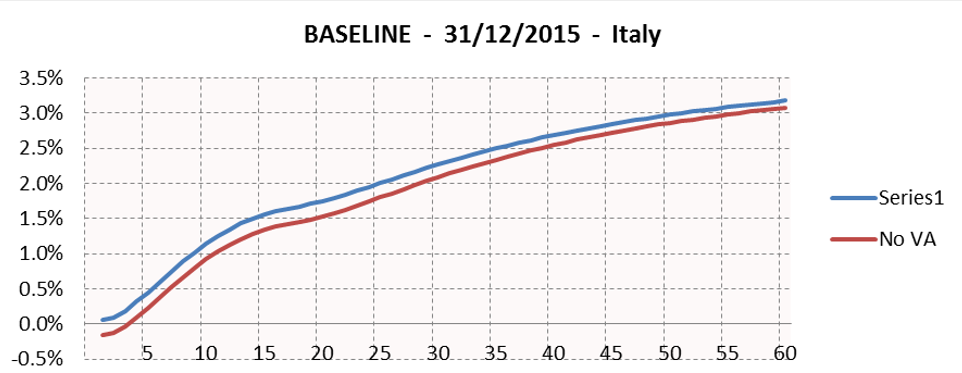
2. Low for long: it is focused on a prolonged low yield environment.
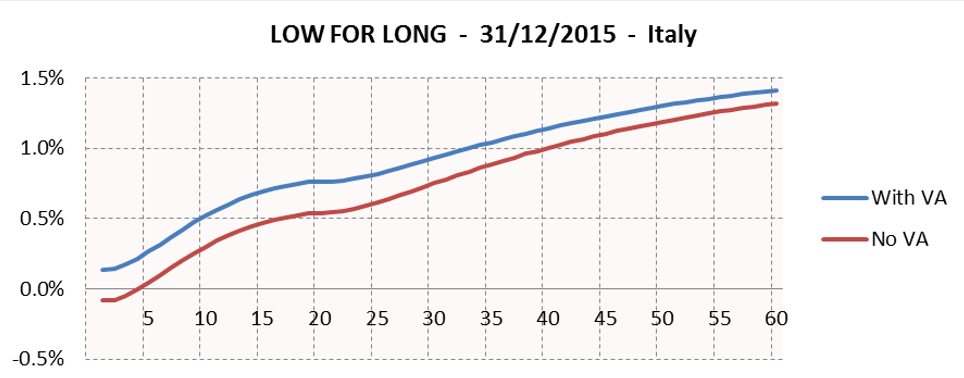
It has been specifically designed by EIOPA looking at the lowest spot rates recently observed in the market (EUR in the past 2 years): the liquid part of the curve (till 20y for EUR) is shifted with a downward shock of 15bps including the CRA and the extrapolation is carried out with an UFR reduced to 2% given the low level of the rates. This value is in line with the inflation target set by the ECB, assuming that no changes in the trend are foreseen for the near future (no growth in the next 60y). The other parameters, like the spreads and the volatility adjustment, are considered unchanged with respect to the base line valuation.

 3. Double hit: it assumes two financial market shocks to materialize simultaneously. A fall in swaps rates and a rapid increase in yields of sovereign bonds (that leads to a steepening of cash yield curves) are assumed to be instantaneous and simultaneous (no need to further aggregate the results through a correlation matrix).
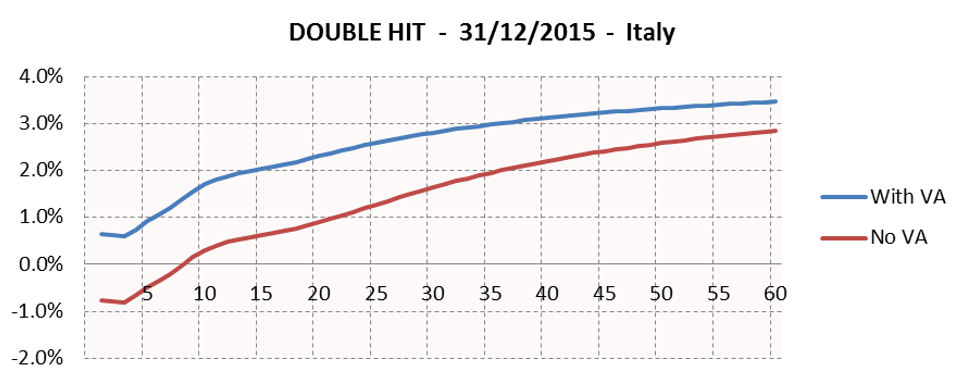
This scenario has been developed in collaboration with the ESRB (European Systemic Risk Board) to assess the systemic risk in the EU financial system. It assumes a generalized increase in risk premia: the required rate of return for holding long-term fixed income assets increases sharply (bond prices decline consequently), concerns on the creditworthiness of some EU sovereigns are set alight again and yields of non-financial corporate and bank debt increase as well. Shocks to credit spreads are made worse by worries on the mark-to-market losses of fixed-income assets (the credit spread for the AAA class barely increase, but weaker issuers are impacted). Higher cost of finance and lower expected demand deteriorate the prospects of future earnings of the EU corporate sector, causing a fall in the stock prices. Financial assets are sold and the excess of liquidity is invested in very short term assets, reducing the forward interest rates and therefore the swaps rates (that reflect expected future short term interest rates).

This scenario assumes a very extreme situation, trigger by two events (fall in swap rates and increase in government yields) never observed simultaneously in the past: the joint probability of the scenario is much lower than the estimated marginal ones (0.50% for swap rates shocks and 0.75% for government yields shocks measured over a one year horizon).
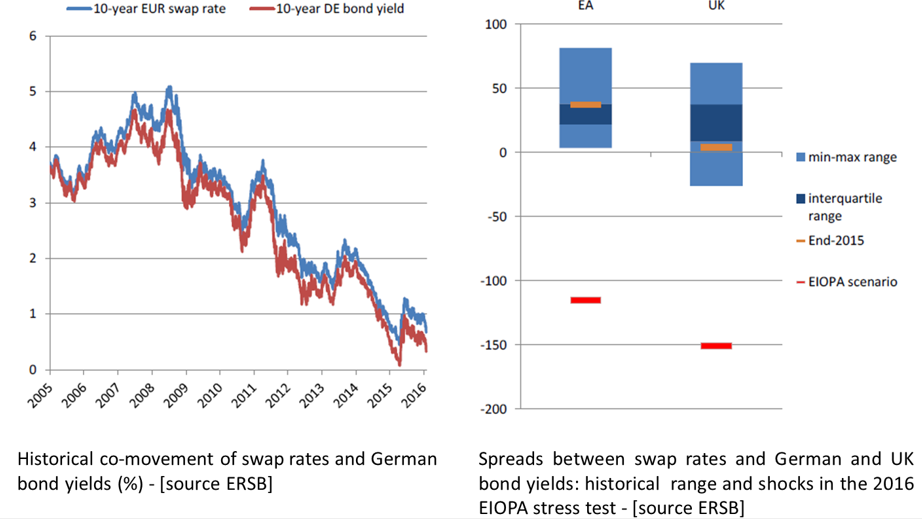
In this scenario swaps rates fall by about 60 to 70 bps, while the EU government bond yields increase on average by 121 bps at the ten year maturity. The value of the latter varies a lot depending on the country (e.g. 78 bps for Sweden, 487 bps for Greece). Stock prices fall on average by 33%, again with high differences on the countries. The proposed calibration is far worse than the one adopted in the 2014 EIOPA stress test.

This double hit scenario impacts both sizes of the insurer’s balance sheets: on the asset side insurers are particularly vulnerable to a fall in global asset prices and on the liabilities side they suffer low risk free interest levels.

EIOPA will analyse the Macaulay duration of the liabilities and the cash flows profile in order to investigate the reinvestment risk and to compare the maturity rate bucketing of asset and liabilities. Unless strictly required by the NSA, sensitivity on the effects of the decline of the interest rates on the derivatives is performed on a voluntary basis, being the risk material just in some jurisdictions.


Nuovi aggiornamenti delle Q&A EIOPA

Lug 21 2016

L’Autorità Europea di vigilanza del mercato assicurativo (EIOPA) ha pubblicato nuovi aggiornamenti ai documenti Q&A (Questions and Answers) pubblicati sul proprio sito istituzionale. In particolare, gli aggiornamenti riguardano:

– Guidelines on the valuation of technical provisions;

– Risk-free interest rate – Matching adjustment;

– Guidelines on reporting and public disclosure;

– Guidelines on the supervision of branches of third-country insurance undertakings;

– Final report on the ITS on the templates for the submission of information to the supervisory authorities.

Sezione Q&A sito EIOPA

Pubblicato Report FSB sulla riforma dei benchmark per i tassi di interesse

Lug 21 2016

Il Financial Stability Board (FSB) ha pubblicato il documento “Reforming Major Interest Rate Benchmarks”. Il documento fornisce un aggiornamento sull’implementazione delle raccomandazioni FSB del luglio 2014 in materia di riforma dei principali indici di riferimento (o benchmark) utilizzati per i tassi di interesse. Rispetto all’indagine precedente, svolta nel luglio del 2015, gli amministratori degli indici più diffusi (i cosiddetti indici IBOR o interbank offered rates) hanno aumentato la convergenza e la conformità alle raccomandazioni FSB. In particolare, i progressi più rilevanti sono stati adottai dagli amministratori degli indici EURIBOR, LIBOR e TIBOR anche grazie all’impegno profuso dalle autorità di vigilanza locali.

Uno dei principali aspetti segnalati dal Board 2014, riguarda l’invito rivolto alle autorità competenti di sviluppare indici di riferimento basati su tassi privi di rischio (risk-free rates o RFRs). La raccomandazione trova fondamento nella constatazione che per alcune tipologie di transazioni finanziarie – tra le quali diverse categorie di strumenti derivati – i tassi di riferimento sono concettualmente prossimi agli RFR.

Le dinamiche individuate dal report (la riforma degli indici IBOR esistenti e l’identificazione di benchmark RFR) sono, secondo lo stesso FSB, ad una fase cruciale del loro processo di attuazione e richiederanno ulteriori sforzi per il loro completamento.

Comunicato stampa
Reforming Major Interest Rate Benchmarks

La Banca d’Italia avvia consultazione sulle disposizioni di vigilanza in materia di gruppo bancario cooperativo

Lug 21 2016

La Banca d’Italia ha pubblicato un documento di consultazione riguardante la normativa secondaria di attuazione della riforma delle banche di credito cooperativo approvata dal Parlamento nell’aprile scorso (decreto-legge 14 febbraio 2016, n. 18, convertito con legge 8 aprile 2016, n. 49). La riforma recentemente introdotta, infatti, attribuisce alla Banca d’Italia il compito di emanare norme di attuazione su diversi aspetti, tra i quali:

– Requisiti minimi organizzativi e operativi della capogruppo;

– Contenuto minimo del contratto di coesione;

– Caratteristiche della garanzia in solido;

– Procedimento per la costituzione del gruppo e l’adesione allo stesso;

– Requisiti specifici dei gruppi provinciali.

L’obiettivo delle disposizioni poste in consultazione è di consentire la creazione di gruppi bancari caratterizzati da unità di direzione strategica e operativa, integrazione della governance e coesione patrimoniale, e perciò capaci di rispettare le regole prudenziali europee, di soddisfare gli standard di supervisione del Meccanismo di Vigilanza Unico e di risolvere autonomamente eventuali difficoltà di singole banche del gruppo. Al contempo, la disciplina proposta è rispettosa delle finalità mutualistiche delle BCC e dà attuazione al principio di proporzionalità dei poteri della capogruppo rispetto alla rischiosità delle banche affiliate, in conformità a quanto previsto dalle nuove norme del TUB.
Le norme in consultazione sono accompagnate da una relazione illustrativa e da un’analisi d’impatto della regolamentazione.

Terminata la consultazione, la Banca d’Italia emanerà le norme definitive. Da quel momento avrà inizio il periodo transitorio (al massimo 18 mesi) previsto dalla riforma per la presentazione alla Banca d’Italia delle iniziative di costituzione dei nuovi gruppi bancari cooperativi.

Pagina sito Banca d’Italia dedicata alla consultazione
Documento di consultazione
Relazione sull’analisi d’impatto

Banca d’Italia: consultazione sulle modifiche al Regolamento sulla gestione collettiva del risparmio

Lug 21 2016

La banca d’Italia ha avviato una consultazione riguardante lo schema di modifica del Regolamento sulla gestione collettiva del risparmio, contenuto nel Provvedimento della Banca d’Italia del 19 gennaio 2015. In particolare, le disposizione proposte mirano a:

– Recepire la disciplina del depositario di fondi comuni di investimento armonizzati (“OICVM”) prevista dalla direttiva UCITS V ed estenderne alcune norme ai depositari di fondi alternativi (FIA);

– Dare attuazione all’art. 46-ter TUF, che stabilisce le condizioni in base alle quali i fondi di credito UE possono concedere finanziamenti in Italia;

– Semplificare la disciplina prudenziale delle SGR sotto soglia;

– Chiarire la portata di alcune disposizioni.

 La consultazione avrà termine il 12 settembre 2016.

Pagina sito Banca d’Italia dedicata alla consultazione
Documento di consultazione

EBA: nuovo Report sulla convergenza delle politiche di vigilanza tra i paesi UE

Lug 21 2016

É stato rilasciato il secondo Report annuale targato EBA sulla convergenza delle pratiche e delle misure di vigilanza adottate dai paesi membri dell’Unione Europea. Il Report, destinato al Parlamento Europeo e al Consiglio, ha esaminato la coerenza e l’organicità delle misure adottate sia per l’applicazione del processo SREP che per la valutazione dei piani di ristrutturazione.
L’analisi condotta mostra un aumento della convergenza delle politiche implementate dalle autorità competenti all’interno dell’UE. Il documento, però, identifica l’esistenza di importanti differenze soprattutto nell’identificazione dell’ammontare dei requisiti patrimoniali addizionali e nella definizione della loro natura legale.

Comunicato stampa
Report convergenza politiche di vigilanza UE

Avviata consultazione ESMA sulla validazione delle metodologie adottate dalle CRA

Lug 21 2016

L’ESMA ha pubblicato un documento di consultazione riguardante la validazione e la revisione delle metodologie impiegate dalle agenzie di rating creditizio (Credit Rating Agencies o CRA). Obiettivo delle disposizioni proposte è di chiarire le aspettative ESMA sulle modalità di validazione e riesame delle metodologie operative poste in essere dalle CRA. Il documento di consultazione, inoltre, identifica le misure che le CRA dovrebbero adottare nel processo di validazione nel caso in cui vi siano limitate evidenze quantitative.
Il documento è accompagnato da un Feedback Statement che raccoglie le criticità principali emerse in risposta alla precedente consultazione lanciata nel dicembre scorso.

La consultazione avrà termine il 22 agosto 2016.

Comunicato stampa
Documento di consultazione
Feedback Statement