In 2005 the IASB & FASB
jointly started a new accounting project in order to reduce the complexities
related to the IAS 39 financial asset classification. This study aims at simplifying
the financial instruments’ classification, hedge accounting rules and better monitoring
financial market evolutions as well as
financial engineering developments.
IFRS 9 is composed by three
main pillars:
- “Classification
and measurement”, which replaces existing categories of financial assets and
liabilities with new ones;
- “Impairment”, that proposes a new forward
looking model, based on expected credit losses instead of already incurred ones;
- “Hedge
accounting”, focused on hedging test simplification and on the extension of eligible
hedging instruments’ perimeter.
IAS 39 provided a single
classification category for loans with credit exposures (“loans and
receivables”) with an amortized cost measurement while the new financial
instruments standard allows two possible measurements for financial assets (amortized
cost and fair value – “FV” -, based on the entity’s business model and
characteristics of the instrument), removing the IAS 39 loan portfolio
constraint.
The IFRS 13 defines fair
value as “the price that would be received to sell an asset or paid to transfer
a liability in an orderly transaction between market participants at the
measurement date”.
Therefore, the introduction
of IFRS 9 allows banks to assign a FV measurement to credit exposures implying
a market driven method where the value is related to market conditions
(buy/sell trades) and not to an amortizing schedule.
These changes regarding the measurement
and the classification of credit portfolios are part of a deeper supervisory review
on the treatment of loans within the regulatory framework:
- Bank of Italy 2006/263 Circular excluded
credit exposures from the regulatory trading book,
- EU 2013/575 Regulation (“Capital Requirements
Regulation”, CRR) firstly opened to this new classification by not strictly
bind credit exposures from the perimeter of the trading book,
- In 2017 the introduction of the ECB “Guidance
on Leveraged Transactions” explicitly stated the opportunity to include loans
in trading portfolios.
Therefore, accounting and
regulatory evolutions confirm a new market trend for loans, considered more as “hybrid
market-credit instruments” than fixed assets to be maintained on balance sheet till
maturity.
Credit supply represents a
fundamental part of the traditional banking activity, generating money to lend from
public savings collection. Credit exposures have always been treated as fixed
assets in banks’ balance sheets. The borrower’s financial stability and
solvency were hence one of a bank’s major concern, which introduced monitoring
systems in order to prevent missed repayments.
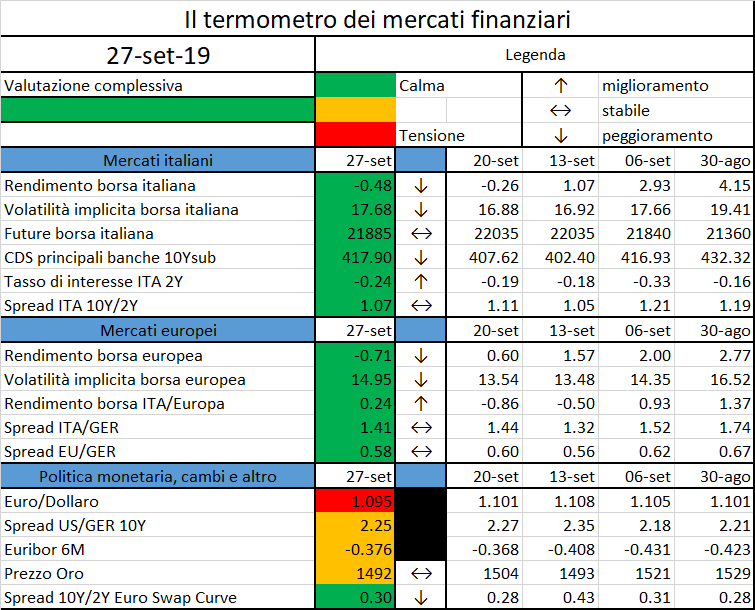
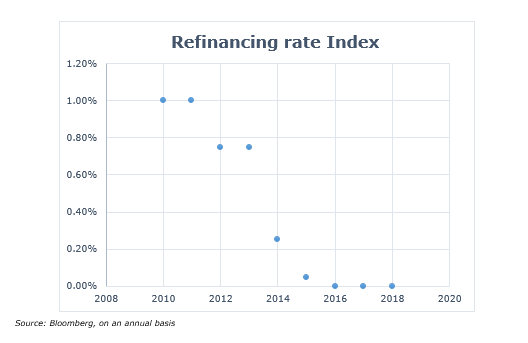
In the last few years, monetary policies focused on liquidity injections carried out by central banks have resulted in a strong reduction of the lending interest rates. This has been leading commercial banks to struggle to reach their profitability targets.
The current economic
situation, as well as the described regulatory developments, has boosted
financial institutions to look for new business opportunities to increase
incomes and reduce costs even in loan management. Innovation has led to:
- buy
and sell loans in order to get capital gains introducing an high frequency loan
trading activity (sustained by quick risk and issue valuations to catch market
momentum),
- dispose
part of the loan portfolio reducing the regulatory capital consumption,
- participate
to ABS, CDO, CLO’s secondary market through the securitization process.
Besides this new credit
portfolio management, there is also the possibility to get higher returns from
advisory, arrangement and structuring activities by receiving upfront and
ongoing fees.
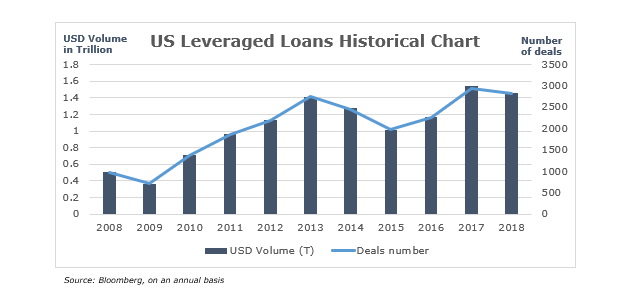
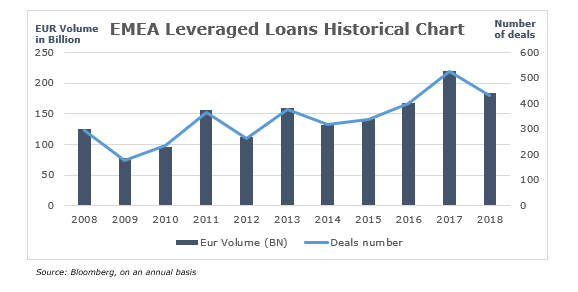
A clear indicator of this continuous change is represented by the huge rise of the Over The Counter leveraged loan market, where loans, disbursed to high leveraged firms, are traded like bonds.
Following this new market driven
view for credit instruments and the related market opportunities, banks face an
important challenge: adapt their processes, functions and systems in order to
produce analyses and valuations granting the correct “time to market”.
The internal processes must
be radically reviewed in order to be agile since the client’s due diligence and
information technology systems need to become dynamic enough to provide on
demand data required for qualitative and quantitative assessments. Easily
accessible databases and quick information flows are necessary also to allow
Risk Management functions to assess risks over the time.
Risk management, in fact,
assumes a fundamental importance due to the establishment of these new
practices; risk-sensitive analyses on instruments must be adequately set up
considering new extended risk frameworks, no longer exclusively represented by default
risk but also by market dynamics. Loans are not considered fixed assets in
balance sheets anymore but they are exchanged in the primary and secondary
market as more “liquid” instruments.
Namely, some strict market risk metrics such as Value at
Risk can be put in place also for loans in accordance to their new hybrid nature
and intent.
This roll-out of metrics is
not simple: new and dedicated methodologies have to be defined according to
some specific credit characteristics of the instrument; in fact loans are
typically tailor-made, not standardized and less liquid than other traded
assets making it necessary to customize Value at Risk calculation in relation
to the credit exposure.
Main methodological aspects
to be considered are:
- approach
(in consideration of time-step and length of historical series),
- confidence
level,
- time
horizon (relating to instruments liquidity/market maturity to sustain daily
calculation),
- yield
to be used (gross or net of funding and/or cost of capital)
- spread
curve to discount future cash flows (potential use of: single name curves,
comparable single name curves, credit spread re-engineered from quoted
obligations, use of CDS index or rating/sector comparable curves).
While on one side the described
dynamic context creates new banking business opportunities, on the other side regulators
have to put increasing attention on banks’ loan management incoming practices.
In recent years, supervisory
authorities have been concerned about the growth of high risk markets such as
leveraged loan one. The financial system and real economy were until recently considered
mature enough for a normalization of monetary policies but, nowadays, due to
several geo-political issues, uncertainty is rising once again.
Because of continuous bank
businesses evolutions, regulators have to carefully supervise any new activity
put in place and its impact on the overall financial system. Financial
sustainability has to be continuously monitored to avoid the dramatic
consequences occurred in 2008. Even if after the financial crisis regulation
constraints have increased, banking activity constantly evolves, forcing the supervisors
to promote effective risk mitigation techniques at the right time.
Joint working groups of
analysis between banks and regulators may set a positive framework in order to converge
a sustainable business, share their different points of view and assess together
adequately risks and opportunities.
European banks have only
started approaching this business. A more dynamic balance sheet, an increasing
focus on brokerage margin, a relevant reduction of regulatory capital
requirements are just some of the benefits of these new practices. Business has
the chance to turn the regulatory evolutions and market trends into new
significant opportunities to increase the profitability and better manage its
portfolio. Furthermore, this new loan management allows firms to access more
easily to the credit supply and consequently to invest in their ideas and
development.
Within this new loan market,
earning opportunities are as relevant as their inherent risks, especially if
related to high leveraged loans. Spreads of leveraged credit exposures allow
institution to get high profits but also expose them to systemic risks
considering intrinsic interrelation of these instruments among banks.
For
this reason, a constant communication between Front Office functions and Risk
Management should be the base to accurately and prudentially participate to these
new business model activities.
Even though Risk Management
structures are essential in defining and monitoring risk appetite frameworks
and limits to this kind of exposure, it is as well really important that market
participants will be able to self-regulate their actions avoiding to take
excessively speculative positions. Given the market driven nature of these
credit instruments, default risk may become a dangerous source of systemic risk
to be burdened by a broader range of entities.
Regulators need to anticipate
or, at least, strictly go hand in hand with the banking business developments
in the eternal conflict between risk and return laying the foundations for a
new and more comprehensive risk valuation which can cover at 360° almost all principal
risks.
A strong and resilient historical memory should be the common base to inspire both banking and regulatory activities for the future.
Autori:
Paolo Gianturco – Business Operations & FinTech Leader
Silvia Manera – Business Operations Director
Tommaso Sacchi – Business Operations Senior Consulting
Nizar Mohamed Saeed Ahmed – Business Operations Analyst
Si ringrazia per il contributo Massimiliano Semprini – Leader of the Italian IFRS Centre of Excellence
Cimini
Riccardo, “Il sistema di bilancio
degli enti finanziari e creditizi”,
Cedam Scienze Economiche e Aziendali, Wolters Kluwer Italia, 2016.
International
Accounting Standard Board, “IFRS 9 – Financial Instruments”, 2014.
International
Accounting Standard Board, “IAS 39 – Recognition and Measurement”, 2003.
International
Accounting Standard Board, “IFRS
13 – Fair Value Measurement”, 2013.
Gazzetta
Ufficiale dell’Unione Europea, “Regolamento (UE) n. 575/2013 del Parlamento
Europeo e del Consiglio del 26 giugno 2013 relativo ai requisiti prudenziali
per gli enti creditizi e le imprese di investimento”.
Banca d’Italia, Eurosistema, “Nuove disposizioni di vigilanza prudenziale
per le banche”, Circolare n. 263 del 27 dicembre 2006.
European Central Bank, Banking
Supervision, “Guidance on Leveraged Transactions”,
2017.
M.
Longo, Il Sole 24 Ore, “Quali sono i
subprime 2.0? Occhi puntati sui leveraged loans made in Usa”, 17 Febbraio 2019.