
Basel committee : incentives to centrally clear over-the-counter (OTC) derivatives

Nov 24 2018

The Financial Stability Board (FSB) and the other standard-setting bodies (SSBs) (i.e. the Basel Committee on Banking Supervision, the Committee on Payments and Market Infrastructures, the Financial Stability Board and the International Organization of Securities Commissions) reconvened the Derivatives Assessment Team (DAT) to “re-examine whether adequate incentives to clear centrally over-the-counter (OTC) derivatives are in place” as one of the first evaluations under the FSB framework for the post-implementation evaluation of the effects of the G20 financial regulatory reforms. The data collected and the analysis conducted by the DAT suggest the following findings:

  1. The changes observed in OTC derivatives markets are consistent with the G20 Leaders’ objective of promoting central clearing as part of mitigating systemic risk and making derivatives markets safer.

    Data from trade repositories and other regulatory reporting shows that central clearing has increased markedly for many types of derivatives, notably interest rate and credit derivatives. Increased clearing is found both for products subject to mandatory clearing and for some that are centrally cleared on a voluntary basis. For example, clearing levels (as measured by notional amounts outstanding) increased from 24% (in 2009) to 62% (in 2017) for interest rate derivatives. Increased clearing levels are found among the large dealing banks and, more recently, among clients.

  2. The relevant post-crisis reforms, in particular the capital, margin and clearing reforms, taken together, appear to create an overall incentive, at least for dealers and larger and more active clients, to centrally clear OTC derivatives.

    Mandatory clearing requirements have led to increased central clearing. The preferential capital treatment of centrally cleared derivatives is considered an important incentive for dealer banks. Analysis of quantitative survey results suggests that the incentive to centrally clear OTC derivatives is also strong where standards requiring the exchange of initial margin for uncleared derivatives trades are in effect. This finding generally holds across a range of product types in different asset classes, but it is not universal. It is supported by regulatory data showing a marked increase in clearing volumes for some non-mandated OTC derivatives around the implementation dates of the margin requirements for uncleared derivatives.

  3. Non-regulatory factors are also important and can interact with regulatory factors to affect incentives to centrally clear.

    Surveys and market outreach show that market participants, especially larger firms, consider that factors such as market liquidity, counterparty credit risk management and netting efficiencies are also important factors for incentives to centrally clear. Regulation can interact with such factors to affect incentives. For example, clearing mandates may shift liquidity into central clearing. Once liquidity is established, market participants may also wish to clear non-mandated products, perhaps to benefit from netting opportunities or a lower capital requirement. On the other hand, the relatively higher fixed costs of accessing central clearing can have a material impact on incentives too, especially for smaller, lower activity firms.3

  4. Some categories of clients have less strong incentives to use central clearing, and may have a lower degree of access to central clearing.

    Mandatory clearing requirements have contributed to an increase in the total number of clients clearing derivatives and increases in the notional cleared by clients overall. However, while there are challenges in identifying effects on small and less active clients in regulatory data, survey responses and information from market outreach suggest that the incentives for them are mixed. Some clients reported a preference not to centrally clear when not required to do so by a clearing mandate.

    There are several factors that may be contributing to this. The benefits of central clearing, such as netting opportunities and deeper liquidity pools, may be lower for smaller clients or for those with more directional positions. Survey responses state that providing connectivity to CCPs requires incurring high fixed costs, which are likely passed on to clients through minimum fees and other charges, increasing clients’ costs of central clearing. For smaller, lower activity clients in particular, this can raise their cost of cleared trades, and thus can have a material impact on their incentives to centrally clear.

    Some smaller clients and some of those with more directional portfolios report experiencing difficulties gaining and/or maintaining access to central clearing. These access issues in turn impact the incentives for these clients to centrally clear.

  1. The provision of client clearing services is concentrated in a relatively small number of bank-affiliated clearing firms.

    The majority of OTC derivatives market participants are not direct clearing members of CCPs, but rather access central clearing as clients through clearing service providers. Therefore, access to client clearing is a key structural feature of the post- reform derivatives markets.

    The provision of client clearing for OTC derivatives remains generally concentrated. For example, five firms, all bank-affiliated, account for over 80% of total client margin for cleared interest rate swaps in the United States, United Kingdom and Japan. Regulatory data illustrates that, although the overall amount of client margin posted at CCPs has increased substantially since the implementation of reforms, the number of clearing service providers has stayed broadly flat over the same period.

    Survey responses and market outreach are also consistent with a view that concentration in clearing service provision could amplify the consequences of the failure or withdrawal of a major provider. In particular, concerns have been expressed about the ability to port client positions and collateral in this situation. This could impact clients’ incentives to centrally clear.

  2. Some aspects of regulatory reform may not incentivise provision of client clearing services.

    Survey data, research and market outreach suggests that some regulations aimed at improving institutional resilience may in some circumstances be discouraging individual firms from providing client clearing services; see below for further discussion. This may in turn affect access challenges for clients and the concentration of client clearing service provision.


Incentives to centrally clear OTC derivatives: A post-implementation evaluation of the effects of the G20 financial regulatory reforms (PDF)

ESMA: Managing risks of a no-deal Brexit in the area of central clearing

Nov 24 2018

The European Securities and Markets Authority (ESMA) is publishing this Public Statement to address the risks of a no-deal Brexit scenario in the area of central clearing. The ESMA Board of Supervisors supports the continued access to UK CCPs to limit the risk of disruption in central clearing and to avoid negatively impacting EU financial market stability.

ESMA therefore welcomes the communication Preparing for the withdrawal of the United Kingdom from the European Union on 30 March 2019: a Contingency Action Plan, published on 13 November 2018 where the EC stated that it will act, to the extent necessary, to address financial stability risks in the EU arising from the withdrawal of the UK without any agreement. In such a scenario the EC has stated that it will adopt a temporary and conditional equivalence decision in order to ensure that there will be no disruption to central clearing.

Therefore, ESMA is engaging with the EC to plan, as far as possible, the preparatory actions for the recognition process of UK CCPs, in case of a no-deal scenario. ESMA has already started engaging with UK CCPs to carry out preparatory work. The aim is to ensure continued access to UK CCPs for EU clearing members and trading venues as of 30 March 2019, should all the conditions in EMIR, including any conditions set out in the equivalence decision, be fulfilled.


Preparing for the withdrawal of the United Kingdom from the European Union on 30 March 2019: a Contingency Action Plan- 1 (PDF)

Preparing for the withdrawal of the United Kingdom from the European Union on 30 March 2019: a Contingency Action Plan – 2 (PDF)

The effect of Long Term Guarantees Measures
di Emilio Barucci

Nov 24 2018
The effect of Long Term Guarantees Measures   di Emilio Barucci

The Solvency II directive requires a review of the long-term (LTG) measures and the measures on equity risk until end of 2020.*

The LTG measures are:

  • the extrapolation of risk-free interest rates,
  • the matching adjustment (MA),
  • the volatility adjustment (VA),
  • the extension of the recovery period in case of non-compliance with the Solvency Capital Requirement,
  • the transitional measure on the risk-free interest rates (TRFR)
  • the transitional measure on technical provisions (TTP).

The equity risk measures are:

  • the application of a symmetric adjustment mechanism to the equity risk charge (SA),
  • the duration-based equity risk sub-module.

783 insurance companies on the European Economic Area uses at least one of these measures, 74% of technical provisions: 730 (66%) use VA, 163 (25%) use TTP, 38 (15%) use MA. 46% of all life insurance undertakings in Europe use VA.

There are eight countries that do use any measure (mostly small central east countries, including Poland).

Removing MA, VA, TRFR, TTP, technical provisions at the European level would go up by €215 bn, Own funds would reduce by €164 bn, the SCR would go up by €73 bn. The average impact in terms of SCR ratio for undertakings using at least one measure at European level would be -69%: Germany (-113%), UK (-108%), Denmark (-80%), Spain (-76%), Portugal (-66%). For Italy it would be almost insignificant: -9%. 11% of undertakings using these measures would be below the SCR and 5% below the MCR.

On average, undertakings that apply the measures MA, VA, TRFR or TTP hold bonds of lower credit quality (in particular Corporate bonds and Government bonds) than undertakings that do not apply any of these measures. Also the duration is longer (in UK is more than the double).

MA is only used in Spain and UK (53% of technical provisions), the average advantage in terms of bps in UK is 110 yielding an advantage of 89% on the SCR ratio. 42% of the companies (in Spain and UK) using the MA would be below 100% without it.

In ten countries (including UK but not Italy), the approval by the authority for the application of the VA is needed. In Italy 95% of technical reserves use the VA, only 35% in UK. The advantage in terms of SCR ratio for undertakings using the VA is mostly for Denmark (80%), Germany (53%), Netherlands (49%), quite limited in Italy and UK (9 and 6%, respectively). The average at the European level is 24%. 3% of undertakings (20) at European level using the VA would be below 100%.

The size of the VA as at end of 2016 for the Euro (it applies to all Euro-countries) is 13 bps (22 in 2015). In UK it was 30 bps. In four countries (Greece, Italy, Portugal, Spain) the country spread is higher than the double of the currency spread but below 100 and therefore it doesn’t provide a contribution (country-VA).

In UK, 54% of technical provisions adopt TTP (mostly Life) with a 47% improvement on the SCR ratio, the effect for all the companies at the European level adopting the TTP is 88% with a huge advantage for French undertakings (139%), Germany (233%), Belgium (135%) and Spain (107%). 26% of undertakings (43) at European level using TTP would be below 100% (13 in Germany and UK, 10 in Portugal).

The market share in technical provisions of undertakings using TRFR is negligible. The effect of equity risk measures is negligible.

169 undertakings adopted TTP or TRFR, of these 60 were required to provide a phase in plan: retention of profits or earnings (27), raising new capital (16), reduction of risk profile (20), change of product design (10), reduction on expenses (17).

It emerges that Italian undertakings do not take advantage in a significant way of Long Term Guarantees measures. Instead there are countries (Germany, UK, Demark, Spain, Portugal, Greece, Norway, The Netherlands) where these measures help significantly to cope with regulatory constraint.


*EIOPA (2017) Report on long-term guarantees measures and measures on equity risk.

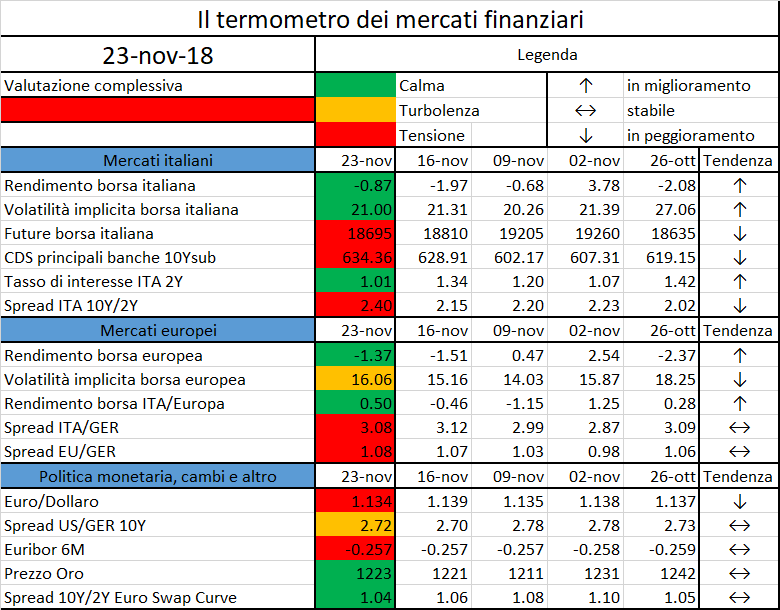
Il termometro dei mercati finanziari (23 novembre 2018)
a cura di Emilio Barucci e Daniele Marazzina

Nov 24 2018
Il termometro dei mercati finanziari (23 novembre 2018)  a cura di Emilio Barucci e Daniele Marazzina

L’iniziativa di Finriskalert.it “Il termometro dei mercati finanziari” vuole presentare un indicatore settimanale sul grado di turbolenza/tensione dei mercati finanziari, con particolare attenzione all’Italia.

Significato degli indicatori

  • Rendimento borsa italiana: rendimento settimanale dell’indice della borsa italiana FTSEMIB;
  • Volatilità implicita borsa italiana: volatilità implicita calcolata considerando le opzioni at-the-money sul FTSEMIB a 3 mesi;
  • Future borsa italiana: valore del future sul FTSEMIB;
  • CDS principali banche 10Ysub: CDS medio delle obbligazioni subordinate a 10 anni delle principali banche italiane (Unicredit, Intesa San Paolo, MPS, Banco BPM);
  • Tasso di interesse ITA 2Y: tasso di interesse costruito sulla curva dei BTP con scadenza a due anni;
  • Spread ITA 10Y/2Y : differenza del tasso di interesse dei BTP a 10 anni e a 2 anni;
  • Rendimento borsa europea: rendimento settimanale dell’indice delle borse europee Eurostoxx;
  • Volatilità implicita borsa europea: volatilità implicita calcolata sulle opzioni at-the-money sull’indice Eurostoxx a scadenza 3 mesi;
  • Rendimento borsa ITA/Europa: differenza tra il rendimento settimanale della borsa italiana e quello delle borse europee, calcolato sugli indici FTSEMIB e Eurostoxx;
  • Spread ITA/GER: differenza tra i tassi di interesse italiani e tedeschi a 10 anni;
  • Spread EU/GER: differenza media tra i tassi di interesse dei principali paesi europei (Francia, Belgio, Spagna, Italia, Olanda) e quelli tedeschi a 10 anni;
  • Euro/dollaro: tasso di cambio euro/dollaro;
  • Spread US/GER 10Y: spread tra i tassi di interesse degli Stati Uniti e quelli tedeschi con scadenza 10 anni;
  • Prezzo Oro: quotazione dell’oro (in USD)
  • Spread 10Y/2Y Euro Swap Curve: differenza del tasso della curva EURO ZONE IRS 3M a 10Y e 2Y;
  • Euribor 6M: tasso euribor a 6 mesi.

I colori sono assegnati in un’ottica VaR: se il valore riportato è superiore (inferiore) al quantile al 15%, il colore utilizzato è l’arancione. Se il valore riportato è superiore (inferiore) al quantile al 5% il colore utilizzato è il rosso. La banda (verso l’alto o verso il basso) viene selezionata, a seconda dell’indicatore, nella direzione dell’instabilità del mercato. I quantili vengono ricostruiti prendendo la serie storica di un anno di osservazioni: ad esempio, un valore in una casella rossa significa che appartiene al 5% dei valori meno positivi riscontrati nell’ultimo anno. Per le prime tre voci della sezione “Politica Monetaria”, le bande per definire il colore sono simmetriche (valori in positivo e in negativo). I dati riportati provengono dal database Thomson Reuters. Infine, la tendenza mostra la dinamica in atto e viene rappresentata dalle frecce: ↑,↓, ↔  indicano rispettivamente miglioramento, peggioramento, stabilità.

Disclaimer: Le informazioni contenute in questa pagina sono esclusivamente a scopo informativo e per uso personale. Le informazioni possono essere modificate da finriskalert.it in qualsiasi momento e senza preavviso. Finriskalert.it non può fornire alcuna garanzia in merito all’affidabilità, completezza, esattezza ed attualità dei dati riportati e, pertanto, non assume alcuna responsabilità per qualsiasi danno legato all’uso, proprio o improprio delle informazioni contenute in questa pagina. I contenuti presenti in questa pagina non devono in alcun modo essere intesi come consigli finanziari, economici, giuridici, fiscali o di altra natura e nessuna decisione d’investimento o qualsiasi altra decisione deve essere presa unicamente sulla base di questi dati.

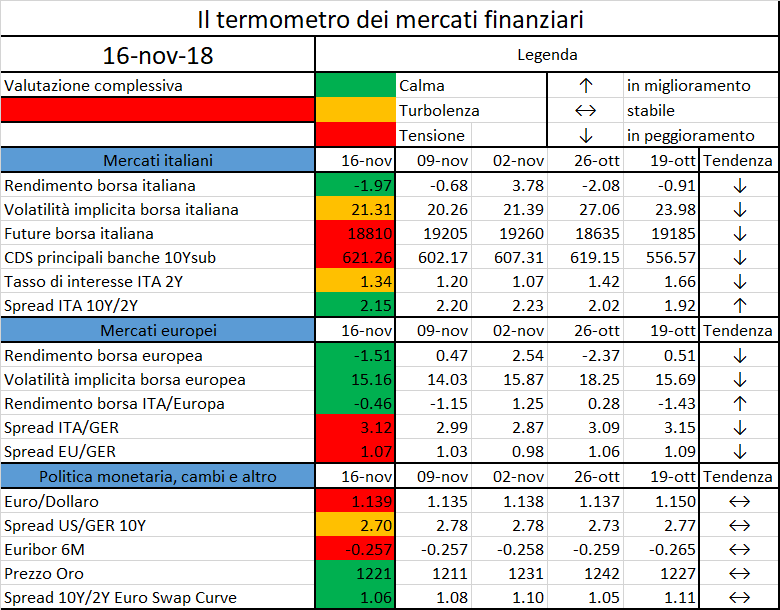
Il termometro dei mercati finanziari (16 novembre 2018)
a cura di Emilio Barucci e Daniele Marazzina

Nov 17 2018
Il termometro dei mercati finanziari (16 novembre 2018)  a cura di Emilio Barucci e Daniele Marazzina

L’iniziativa di Finriskalert.it “Il termometro dei mercati finanziari” vuole presentare un indicatore settimanale sul grado di turbolenza/tensione dei mercati finanziari, con particolare attenzione all’Italia.

Significato degli indicatori

  • Rendimento borsa italiana: rendimento settimanale dell’indice della borsa italiana FTSEMIB;
  • Volatilità implicita borsa italiana: volatilità implicita calcolata considerando le opzioni at-the-money sul FTSEMIB a 3 mesi;
  • Future borsa italiana: valore del future sul FTSEMIB;
  • CDS principali banche 10Ysub: CDS medio delle obbligazioni subordinate a 10 anni delle principali banche italiane (Unicredit, Intesa San Paolo, MPS, Banco BPM);
  • Tasso di interesse ITA 2Y: tasso di interesse costruito sulla curva dei BTP con scadenza a due anni;
  • Spread ITA 10Y/2Y : differenza del tasso di interesse dei BTP a 10 anni e a 2 anni;
  • Rendimento borsa europea: rendimento settimanale dell’indice delle borse europee Eurostoxx;
  • Volatilità implicita borsa europea: volatilità implicita calcolata sulle opzioni at-the-money sull’indice Eurostoxx a scadenza 3 mesi;
  • Rendimento borsa ITA/Europa: differenza tra il rendimento settimanale della borsa italiana e quello delle borse europee, calcolato sugli indici FTSEMIB e Eurostoxx;
  • Spread ITA/GER: differenza tra i tassi di interesse italiani e tedeschi a 10 anni;
  • Spread EU/GER: differenza media tra i tassi di interesse dei principali paesi europei (Francia, Belgio, Spagna, Italia, Olanda) e quelli tedeschi a 10 anni;
  • Euro/dollaro: tasso di cambio euro/dollaro;
  • Spread US/GER 10Y: spread tra i tassi di interesse degli Stati Uniti e quelli tedeschi con scadenza 10 anni;
  • Prezzo Oro: quotazione dell’oro (in USD)
  • Spread 10Y/2Y Euro Swap Curve: differenza del tasso della curva EURO ZONE IRS 3M a 10Y e 2Y;
  • Euribor 6M: tasso euribor a 6 mesi.

I colori sono assegnati in un’ottica VaR: se il valore riportato è superiore (inferiore) al quantile al 15%, il colore utilizzato è l’arancione. Se il valore riportato è superiore (inferiore) al quantile al 5% il colore utilizzato è il rosso. La banda (verso l’alto o verso il basso) viene selezionata, a seconda dell’indicatore, nella direzione dell’instabilità del mercato. I quantili vengono ricostruiti prendendo la serie storica di un anno di osservazioni: ad esempio, un valore in una casella rossa significa che appartiene al 5% dei valori meno positivi riscontrati nell’ultimo anno. Per le prime tre voci della sezione “Politica Monetaria”, le bande per definire il colore sono simmetriche (valori in positivo e in negativo). I dati riportati provengono dal database Thomson Reuters. Infine, la tendenza mostra la dinamica in atto e viene rappresentata dalle frecce: ↑,↓, ↔  indicano rispettivamente miglioramento, peggioramento, stabilità.

Disclaimer: Le informazioni contenute in questa pagina sono esclusivamente a scopo informativo e per uso personale. Le informazioni possono essere modificate da finriskalert.it in qualsiasi momento e senza preavviso. Finriskalert.it non può fornire alcuna garanzia in merito all’affidabilità, completezza, esattezza ed attualità dei dati riportati e, pertanto, non assume alcuna responsabilità per qualsiasi danno legato all’uso, proprio o improprio delle informazioni contenute in questa pagina. I contenuti presenti in questa pagina non devono in alcun modo essere intesi come consigli finanziari, economici, giuridici, fiscali o di altra natura e nessuna decisione d’investimento o qualsiasi altra decisione deve essere presa unicamente sulla base di questi dati.

ECB: current challenges in the Euro-area banking sector

Nov 16 2018

Luis de Guindos, Vice-President of the ECB spoke at  the Annual General Meeting of the Foreign Bankers’ Association, which was held in Amsterdam the 15 November 2018. The focus was the state of the euro area banking sector and its current challenges.

 The financial health of euro area banks has improved markedly since the beginning of the crisis. The aggregate core capital (Common Equity Tier 1) ratio of euro area banks stood at around 14% at the end of the second quarter of 2018, the double of what is was in 2007. Regulatory liquidity ratios are at solid levels, with an aggregate liquidity coverage ratio of 141%. European banks are also making progress in fulfilling the minimum requirements for own funds and eligible liabilities (MREL).

One indicator of this is that the volume of Additional Tier 1 bonds and Tier 2 instruments issued by euro area banks and held by investors in the euro area increased by two-thirds between 2013 and 2017. Finally, banks are also making progress in repairing their balance sheets – the aggregate non-performing loan (NPL) ratio has nearly halved from its 2013 peak of around 8%, to its current level of 4.4%.

The recently published results of the 2018 stress tests reflect exactly this. On average, core capital of euro area banks after stress stood at 9.9%, up from 8.8% in the same exercise two years ago. Underlying the results is the strong build-up of capital buffers in recent years resulting in a better condition at the starting point of the exercise (end 2017).

While euro area banks are clearly better capitalised and more resilient, this exercise should not hide the fact that areas of vulnerability remain. In particular, banks are still struggling to achieve sustainable profitability. Admittedly, headline profitability figures show that the sector seems to be improving rapidly – the average return on equity for euro area banks increased from 3.4% in 2016 to 6.9% in the second quarter of 2018. However, more careful analysis reveals that this improvement is mainly due to a reduction in the cost of credit risk. This results, in part, from a cyclical upswing that has stemmed the flow of new NPLs and led to provisioning costs falling to post-crisis lows. At the same time, operating profits have remained modest overall and the average cost-to-income ratio flat at 66% over the same period, reflecting some cyclical and structural challenges.

On the cyclical front, banks are finding it hard to increase their revenue in the low interest rate environment. Although credit growth has increased somewhat with the improving economic conditions, it is not yet sufficient to compensate for the low interest rate margins. The continued economic recovery should, however, reduce the negative impact of cyclical factors over time, as banks’ balance sheets adjust.

But most importantly, a number of structural challenges continue to dampen bank profitability. These factors vary across countries and banks and include incomplete business model adjustments, cost inefficiencies and excess capacity. The stock of NPLs also remains high at some banks.

On the positive side, the growing economy and the ever more resilient banking sector are supporting financial stability. This is partly why the financial system has recently proved resilient to volatility, and why contagion across countries and markets has remained limited. But these developments need to be put into the context of the continuing search for yield in the markets, rising trade protectionism, and political and policy uncertainty, which increase risks to financial stability.

Taking these factors together, the euro area financial sector is faced with risks, which can be classified in three categories. First, the factors that are related to the past, in other words, the legacy of the crisis, include a still-significant private and public debt overhang. Second, the current expansion of the US is now significantly longer than historical norms and the second longest in US modern history. Third, in Europe, debt sustainability concerns have risen both in the public and private sector. As regards public finances, Italy is the most prominent case at the moment in light of the overall debt level and the political tensions around the Italian government’s budget plans. Contagion to other European sovereigns has however been limited.

In sum, there is no reason to be complacent about financial stability risks in the banking sector, which could materialise in a number of ways. At the current opportune moment with 22 consecutive quarters of economic growth behind us, minds should be concentrated on tackling structural impediments to sustained profitability in the euro area banking sector.

Banks need to adjust their business models to further diversify their income and reduce cost inefficiencies. They should also prepare for the challenges of digitalization and competition from technology companies. And it is of the utmost importance that the large stocks of NPLs that still remain in some banks are reduced.

ECB: Euro area banking sector – current challenges (complete speech, HTML)

FSB and the IAIS proposal for the insurance systemic risk framework

Nov 16 2018

The Financial Stability board (FSB) welcomes the publication today of the International Association of Insurance Supervisors (IAIS) consultation document on a proposed holistic framework for the assessment and mitigation of systemic risk in the insurance sector. It sets out the Activities-Based Approach for sector-wide risk monitoring and management, as a key component of the framework, and tools for dealing with the build-up of risk within individual insurers. The FSB notes that a new holistic framework, appropriately implemented, would provide an enhanced basis for mitigating systemic risk in the insurance sector.

The IAIS will further refine the proposed holistic framework, taking account of the public consultation feedback, including feedback on the scope of application of the supervisory measures to ensure proportional application. The specific measures to be incorporated in the IAIS supervisory material (Insurance Core Principles and Common Framework for the Supervision of Internationally Active Insurance Groups, ComFrame) will then be exposed for further public consultation. The IAIS will finalise the holistic framework in 2019, for implementation in 2020.

In light of the progress with the proposed holistic framework, the FSB, in consultation with the IAIS and national authorities, has decided not to engage in an identification of global systemically important insurers (G-SIIs) in 2018. The FSB will assess the IAIS’s recommendation to suspend G-SII identification from 2020 once the holistic framework is finalised in November 2019. In November 2022, the FSB will, based on the initial years of implementation of the holistic framework, review the need to either discontinue or re-establish an annual identification of G-SIIs by the FSB in consultation with the IAIS and national authorities.

In the period until the holistic framework is implemented, the relevant group-wide supervisors have committed to continue applying existing enhanced supervisory policy measures as described in the IAIS consultative document on the holistic framework published today, as applicable.

The FSB will receive from the IAIS an annual update of the IAIS assessment of systemic risk in the global insurance sector and of the supervisory response. The IAIS will continue its annual global monitoring exercise, including the annual data collection from individual insurers building on the current G-SII data collection template and instructions and implement additional data collection from supervisors as necessary to support an assessment of sector-wide trends with regard to specific activities and exposures.


IAIS: proposed holistic framework for the assessment and mitigation of systemic risk in the insurance sector and implications for the identification of G-SIIs and for G-SII policy measures

IOSCO seeks feedback on proposed framework for assessing leverage in investment funds

Nov 16 2018

The Board of the International Organization of Securities Commissions (IOSCO) is requesting feedback on a proposed framework to help measure leverage used by investment funds which in some circumstances could pose financial stability risks.

The proposed framework, outlined in IOSCO Report: Leverage, comprises a two-step process aimed at achieving a meaningful and consistent assessment of global leverage. The first step indicates how regulators could exclude from consideration funds that are unlikely to create stability risks to the financial system while filtering and selecting a subset of other funds for further analysis.

The second step calls for regulators to conduct a risk-based analysis of the subset of investment funds identified in the first step. The consultation paper principally focuses on the first step, although it also invites feedback on both the second step and the design of the two-step approach.

IOSCO does not prescribe a particular set of metrics or other analytical tools. Instead, each jurisdiction is expected to determine which is the most appropriate risk assessment for it to adopt, given that some risk-based measures are not appropriate for all funds.

The two-step framework seeks an appropriate balance between achieving precise leverage measures and devising simple, robust metrics that can be applied in a consistent manner to a wide range of funds in different jurisdictions. It also addresses synthetic leverage, by including exposure created by derivatives; considers different approaches to analyzing netting and hedging and the directionality of positions; and includes approaches that limit model risk.

The consultation paper responds to a request made in the Financial Stability Board ́s 2017 report Policy Recommendations to Address Structural Vulnerabilities from Asset Management Activities, which provides policy recommendations to address risks to global financial stability arising from potential structural vulnerabilities that may result from asset management activities.

Recommendation 10 in the FSB report asks IOSCO to “identify and or develop consistent measures of leverage in funds to facilitate more meaningful monitoring of leverage for financial stability purposes and help enable direct comparisons across funds and at a global level. IOSCO should also consider identifying and/or developing more risk-based measure(s) to complement the initial measures with a view to enhance authorities’ understanding and monitoring of risks that leverage in funds may create. In both cases, IOSCO should consider appropriate netting and hedging assumptions and where relevant build on existing measures.”

IOSCO: feedback on proposed framework for assessing leverage in investment funds (PDF)

Basel Committee: Leverage ratio treatment of client cleared derivatives

Nov 16 2018

A key element of the Basel Committee’s post-crisis Basel III reforms is the introduction of a leverage ratio requirement. The leverage ratio complements the risk-based capital requirements by providing a safeguard against unsustainable levels of leverage and by mitigating gaming and model risk across both internal models and standardised risk measurement approaches. By design, the leverage ratio does not differentiate risk across different asset classes.

This consultative document seeks the views of stakeholders on whether a targeted and limited revision of the leverage ratio’s treatment of client cleared derivatives may be warranted, based on the findings of the Committee’s review of the impact of the leverage ratio on banks’ provision of client clearing services and in consideration of key policy objectives of G20 Leaders both to prevent excessive leverage and improve the quality and quantity of capital in the banking system and to promote central clearing of standardised derivatives contracts.

Pending feedback provided in response to this consultation, the range of treatments that the Committee may consider include:

  • no change to the current treatment;
  • an amendment to the treatment of client cleared derivatives to allow cash and non-cash initial margin received from a client to offset the potential future exposure of client cleared derivatives; and
  • alignment of  the treatment of client cleared derivatives with the standardised approach for measuring counterparty credit risk exposures. This would have the effect of allowing both cash and non-cash forms of initial margin and variation margin received from a client to offset the replacement cost and potential future exposure amounts of client cleared derivatives.

The Committee also welcomes feedback on the merits of introducing a requirement for initial margin to be segregated in order for any amended treatment to apply. It also seeks views on forward-looking behavioural dynamics of the client clearing industry that might result from any amended treatment.

Basel Committee: Leverage ratio treatment of client cleared derivatives (PDF)

Future of credit risk
a cura di Deloitte Italia

Nov 15 2018
Future of credit risk   a cura di Deloitte Italia

Upcoming challenges and new trends for financial institutions

Credit risk management in the banking industry has changed in recent years, mainly as a consequence of the stricter regulations following the financial crisis; further changes, whose magnitude and effects are mostly not predictable, will have an impact in the next decade on its role, scope and organization.

The definition, development and implementation of the interventions needed to keep pace with these changes will require important investments by banks in terms of adoption of new technologies, redefinition of processes and organization, and will imply the need to overcome several challenges. These investments are expected to be compensated by economic returns in the medium-long run, through the possibility to re-allocate staff to more valuable activities, to provide managers with automatic and more comprehensive flows of information fundamental for their strategic decisions and to obtain capital savings thanks to more predictable internal models.

The main trends currently affecting the risk management function, deemed to have an even more important impact in the near future, are related to regulatory topics, digitalization and practices optimization, business development and new risks prevention.

Evolution in the regulatory framework

Financial institutions have recently been facing more stringent regulation therefore significantly expanding their risk management functions. Among the latest regulatory developments affecting credit risk, in December 2017 the legal provisions revising and integrating the Basel III framework, frequently referred to as ‘Basel IV’, have been launched by the Basel Committee. The new dispositions mainly aim to further reduce the variability in the measurement of the RWAs among banks with different dimensions, operating according to diverse regulatory frameworks and business models.

Besides ‘Basel IV’ reforms, in November 2017 the EBA published specific guidelines focused on modelling techniques for the estimation of IRB parameters for defaulted and non-defaulted exposures.

Additionally, it is worth mentioning the process currently being structured by the ECB in order to address the implementation by banks of the new definition of default. The new regulatory framework aims to harmonize the criteria of identification of the default status at European level, therefore minimizing the variability of the RWAs.

Finally, the digitalization process of banking processes currently underway will increase the new regulation issued for the purposes of governing and control this new fields.

Digitalization and practices optimization

Banks business and operational models have evolved in the last decade due to the process of digitalization; it implies the transformation of existing processes by leveraging on the application of digital technologies and data in order to create new value and opportunities. Digitalization represents for the banking industry and risk management the most effective way to reduce costs in a context of persistent margin decline, which is a direct consequence of:

  • competition of aggressive FinTechs and banks early-adopting new technologies, with low-cost business models and automated processes, enabling them to provide customers with different kind of offerings;
  • low interest rates condition affecting the whole industry;
  • increasing regulation, which caused the growth of risk management functions in terms of staff and costs in the last years.

Among tools useful for the risk management function to successfully compete in this evolving framework, advanced analytics and big data systems have already started to prove their effectiveness:

  • advanced analytics: new technological and statistical tools (e.g. machine learning) capable to identify complex patterns in richer datasets, enabling the estimation of more accurate and predictive internal models and the reduction of credit losses;
  • big data systems: data processing software enabling the analysis of greater amounts of structured and unstructured data in a faster way, made possible by the increased computation power of modern technologies.

 Business development

Technological innovation led customers to increasingly demand digital banking services, to be accessible at anytime from any devices, in order to support their everyday decisions. Social media and e-commerce have acquainted clients by means of personalization and brisk fulfilment of their requests. Consequently, it is fundamental for financial institutions to prioritize their digitalization efforts in order to be abreast of the rapid developments in this area. The challenge for banks over the coming years is to be present in key moments of customers’ life, anticipating and satisfying their financial needs while foreseeing variations in their purchasing preferences.

With this aim, advanced statistical algorithms and artificial intelligence systems applied to risk management models and processes will play a fundamental role in meeting customers’ expectations and facilitating business development, anticipating clients’ needs and providing customized solutions. Consequently, the risk function will be called upon to collaborate jointly with each business in order to respond to customers’ demands while limiting risks mainly related to the complexity of supporting processes.

 New risks prevention

Beside regulatory risk types such as credit, liquidity, market and operational risk, specific non-financial risks are emerging as result of structural changes concerning financial institutions, including models’ greater complexity, the introduction of digitalization and automation in many processes, as well as the growth of interconnectedness among market players. In this light, new regulations are progressively addressing additional risk types, which are not properly new, but due to their growing importance and their impact on the financial system, deserve accurate management.

Among others, models’ increasing complexity stemming from the adoption of advanced analytics techniques entails the so-called model risk, occurring when a model performs inadequately. It usually derives from underlying data quality or data management issues resulting in misleading outcomes and operational losses; or due to the incorrect model estimation and execution intended as technologies and processes provided to end users to effectively conduct daily operations. To this extent, the optimization of model risk management is becoming a core part of risk activities.

 Regulatory expectations on the role of FinTechs

In light of the cross-sectoral transformation of the financial industry, the main Supervisory Authorities are carrying out exercises in order to gather information about the range of financial services provided and innovations applied by FinTechs. The main purpose of the Supervisors is to define the related regulatory treatment and the main areas of intervention, focusing on the following aspects: (1) accessibility of financial services to customers, (2) bringing down operational costs and increasing the efficiency of the financial services sector, (3) enhancing competition in the Single Market by lowering barriers to entry, and (4) balancing greater data sharing and transparency with data security and protection needs.

The main results gathered so far made it possible to identify follow-up initiatives and a roadmap at European level for the following years. In particular, regulators’ expectations are focused on the promotion of technological developments in order to allow opportunities in the FinTech perimeter, while it is of primary importance to ensure consumer protection, as well as integrity of financial markets through sector-specific regulation to be issued.

 Impact on credit risk management

In light of the latest evolutions in the regulatory framework, banks are facing, at the same time, an increase in compliance costs – financial institutions will be required to plan an impactful revision of their credit risk-measurement models, as well as of the related internal processes and IT systems – and a reduction in returns due to the raise in capital and liquidity requirements.

On the other side, digitalization represents the opportunity for the banking industry to reduce costs through the use of advanced data analytics and big data systems, enabling the provision of more accurate and performing internal models, leveraging on the automation in order to speed up their development timings and simultaneously reduce the need for manual inputs. To this end, the adoption of new technologies will certainly require the involvement of professional resources characterized by widened analytical-oriented skills.

Additionally, advanced statistical algorithms applied to credit risk management models and processes will play a fundamental role in meeting customers’ expectations and providing customized solutions, likely facilitating business development and making banks more competitive on the market, where FinTechs have become a player of interest for clients. Digitalization will facilitate banks in the processes implying the use of internal models, such as – for instance – credit granting, management reporting and pricing policies. To this purpose, banks will be required to reshape their credit risk management functions, which will be called upon working alongside with several structures, such as business, operations and finance departments; this collaboration will in turn spread and enhance credit risk culture among other strategic areas.

The effectiveness and timely response of banks to the above mentioned trends, and their ability to adapt business models and processes to the evolving environment, will determine their future competitive success. In this context, credit risk management will have the chance to play an important role as one of the leading functions in banks’ strategic change.


Antonio Arfè – Partner Deloitte Consulting

Francesco Zeigner – Partner Deloitte Consulting

Vincenzo Maria Cosenza – Senior Manager Deloitte Consulting